Diamond quantum computer: a revolution in a computer bay
Discover SAXON Q diamond quantum computer, a machine operating at room temperature without cryogenic cooling.
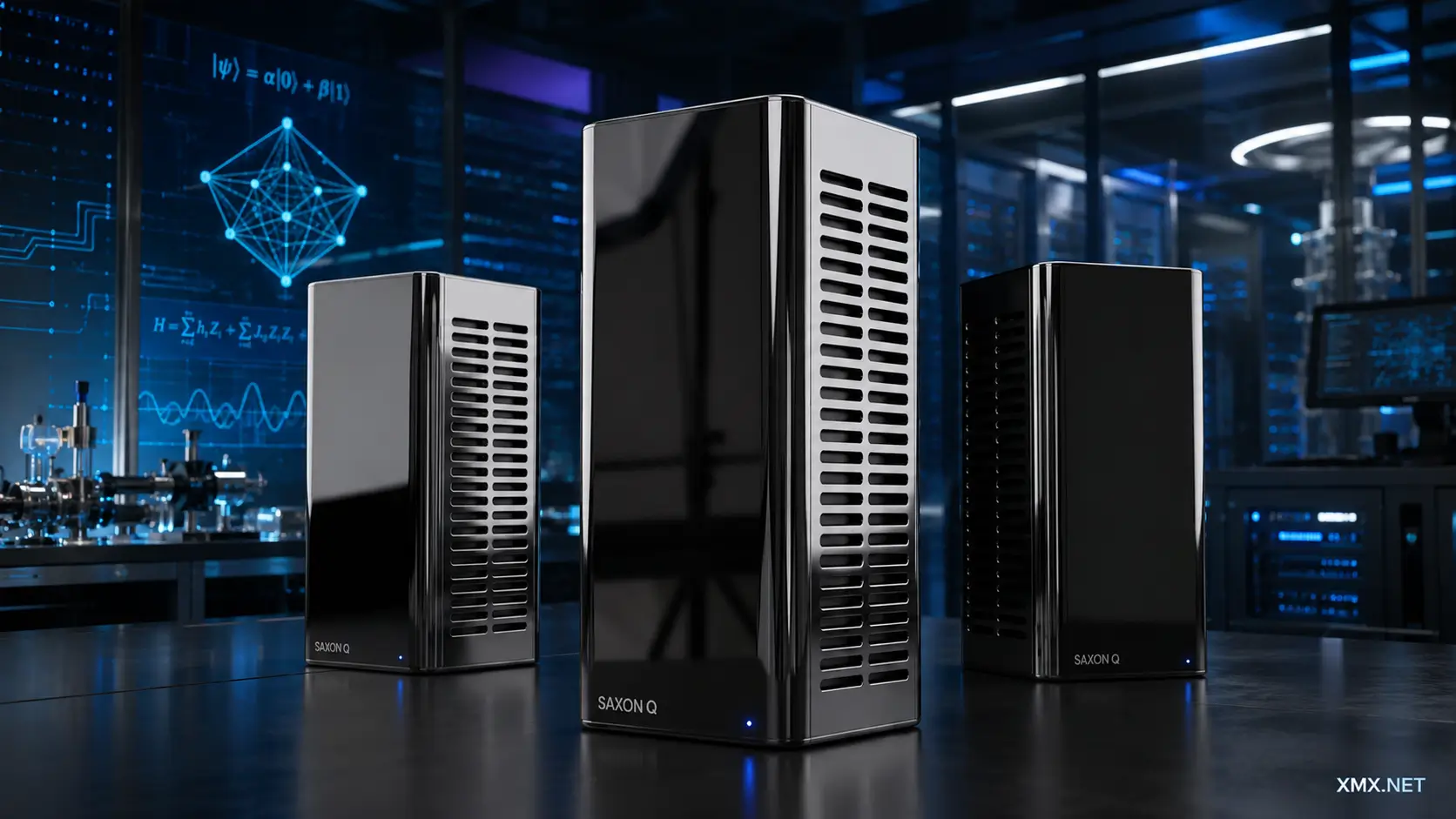
Imagine a quantum computer that does not need a cryogenic chamber or a temperature close to absolute zero. A machine that can be installed in a standard computer bay and connected to a conventional power supply. This is precisely what SAXON Q, a German company from Leipzig's scientific ecosystem, proposes.
The company has just opened orders for the SXQ128, presented as a 128-bit quantum computer operating at room temperature. A 512-Qubit model, SXQ512, is announced for 2027. If the claimed performance is confirmed, this approach could contribute to the progressive release of quantum computing from specialized laboratories.
Why are quantum computers normally so cold?
A conventional computer handles bits representing a 0 or a 1. A quantum computer instead employs qubits, capable of exploiting phenomena such as superposition and intrication.
The problem is that these quantum states are extremely fragile. Heat, vibration and electromagnetic disturbances can cause the loss of quantum information. Superconducting processors developed by IBM and Google in particular must therefore be cooled to a few thousand degrees above absolute zero, i.e. close to -273 °C.
This requirement imposes complex cryogenic refrigerators, specialized infrastructure and considerable operating costs. SAXON Q bypasses the problem using a completely different physical architecture.
Imperfections that give its power to the diamond
The SAXON Q processor is based on synthetic diamonds containing ** nitrogen-lacune centres**, also called NV centres, for nitrogen-vacancy.
In the normally regular structure of the diamond, a nitrogen atom takes the place of a carbon atom, just next to a space left vacant. The electron associated with this imperfection has a quantum state that can be initialized and read with laser light and then manipulated by microwave pulses.
The diamond protects this state relatively well against surrounding disturbances. That's what allows the Qubits to operate at room temperature, without the extreme cooling required by several other quantum architectures.
The concept is not new. The real obstacle was to produce enough stable, well-positioned and usable NV centres. SAXON Q states that it improved this performance using a sulphur co-location method. According to the company, over 85% of the implanted atoms would thus produce functional NV centres, compared to about 1 to 10% with traditional methods.
A really transportable quantum computer
The announced result is a system that holds in a server bay, operates on a normal power supply and does not require cryogenic cooling, vacuum equipment, or particular laboratory environment.
It is not just a prototype shown at a conference. Since June 2025, the Fraunhofer Institute IWU in Dresden has operated an earlier generation mobile quantum computer designed by SAXON Q. It operates at room temperature and is used to explore industrial applications such as intelligent production systems, automobiles, aerospace and mechanics.
SAXON Q now targets more demanding uses: molecular simulation, material research, industrial optimization, robotics and hybrid algorithm development combining classical and quantum calculations.
128-Qubits should be interpreted with caution
The SXQ128 is presented as a 128-Qubit machine, but this figure does not mean that the 128-Qubits form a single fully intrigued processor. The device adopts a multi-heart architecture in which each heart has eight fully intrigued quadits. The future SXQ512 would count sixteen by heart.
This distinction is important: only comparing the total number of qubits of two quantum computers can be misleading. The fidelity of operations, the connectivity between the Qubits, their speed, the correction of errors and the ability to run a useful algorithm often count more than the figure on the data sheet.
SAXON Q announces a loyalty of 99.92% for some operations and would have obtained up to 99.98% in more recent single-bit trials. These data are encouraging, but have not yet been fully independently verified. According to Live Science, no accessible scientific publication yet clearly demonstrated the operation of a complete computer based on this architecture with more than ten quibits at the time of the announcement.
#A serious breakthrough, but not yet a demonstrated revolution
The quantum diamond computer will not replace conventional servers tomorrow, nor will it instantly transform every company into a quantum laboratory. Quabit density remains limited, NV systems can be slower than some competing architectures, and large-scale error correction remains a major challenge.
Nevertheless, progress is important. Quantum computing has so far been mainly about large, extremely cold and remote installations via the cloud. A quantum machine that is continuously operating at room temperature and can be installed on site changes the way it is intended to deploy.
The SAXON Q bet is therefore not just to increase the number of quibits. It consists of making the quantum computer compact enough, stable and convenient so that it can one day take place next to conventional servers. And if this promise is fulfilled on a large scale, the diamond could become much more than a precious stone: it could become one of the key materials of the next computer generation.
Sources
- SAXON Q — Official presentation of SXQ128 and SXQ512 (https://www.iwu.fraunhofer.de/en/press/2025-Fraunhofer-IWU-operators-Saxonys-First-Mobile-Quantum-Computer.html)
- German Aerospace Centre — How diamonds become Qubits (https://www.livescience.com/technology/quantum/scientists-build-a-room-temperature-quantum-computer-with-diamond-based-qubits)
- The Quantum Insider — Architecture, Loyalty and Commercial Availability