The future settles without warning: the technologies that mark the week
Discover the main technologies announced this week: voice AI, 3D screens, sustainable phones, natural programming and space innovation.
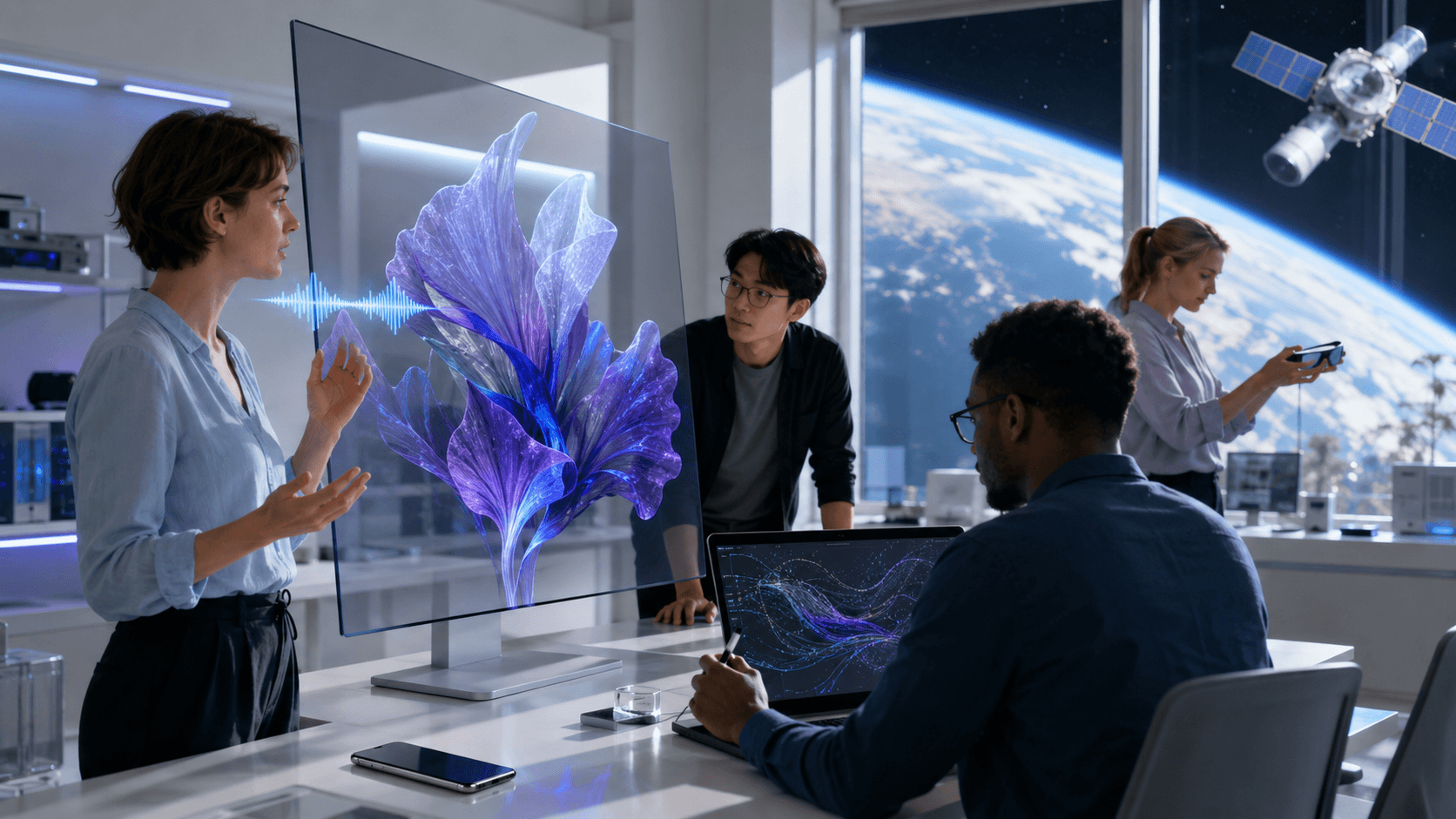
*An overview of the main technologies announced or launched around the world at the beginning of the week of August 3, 2026. *
The world of technology no longer advances through large isolated revolutions. It is now progressing through a rapid succession of improvements that, together, profoundly transform our way of working, communicating and interacting with our environment.
Since the beginning of the week, several announcements illustrate this development. Vocal assistants become more natural, educational tools become more autonomous, screens produce three-dimensional effects without glasses and mobile devices rely more on life expectancy than mere power.
As we are only at the beginning of the week, this review covers announcements published mainly on August 3rd and 4th, 2026**, as well as some presentations made public in international markets during this period.
Voice assistants learn to converse naturally
Traditional voice assistants usually work according to a rigid structure: the user speaks, the system waits, analyses the demand, and then responds. This mechanics often create artificial silences or unpleasant interruptions.
OpenAI presented this week the architecture of GPT-Live, a vocal system designed to listen and speak simultaneously. This "full duplex" technology allows artificial intelligence to maintain a much more fluid conversation.
The system can also view other models or use tools in the background without blocking voice exchange. For example, it could continue to discuss with the user while another model conducts a complex search or analysis of information.
The company also worked on the start-up of real-time communications. A series of optimizations to WebRTC, a technology widely used to transmit audio and video over the Internet, significantly reduces the number of network exchanges needed to establish a connection.
Discover GPT‐Live architecture
This could improve customer services, translation systems, accessibility tools, professional assistants and voice interfaces built into connected vehicles or devices.
Digital tools specially designed for education
On August 4, OpenAI also announced new specialized tools for students, students and teachers.
These environments may access educational materials, schedules, course plans and institutionally approved applications with appropriate permission.
In particular, teachers can use them to:
- Prepare course plans;
- Create questionnaires;
- Adapting equipment to different levels;
- Produce visual explanations;
- Organize an educational calendar;
- Design interactive resources.
Students can, for their part, generate study sheets, practical exercises, questionnaires and personalized explanations from the documents they choose.
See announcement on new educational tools
The important technology behind this announcement is not only artificial intelligence generation. This is mainly about the ability of a system to understand the context of a course, consult multiple resources and carry out a series of coherent actions.
Three-dimensional screens free from glasses
Samsung announced the global launch of a new three-dimensional 32-inch commercial screen.
This technology, called Spatial Signage, allows to present products and animations with an impression of depth without forcing spectators to wear special glasses.
Unlike large three-dimensional screens for events or public spaces, this compact model is designed to be installed on counters, windows or commercial shelves.
The aim is to allow retailers to show a product from multiple angles, create a movement impression or give more depth to an advertising presentation.
Samsung supports this material with a content management platform including tools supported by artificial intelligence. These can transform some static images into animated content and automatically adapt them to the particular features of the screen.
Discover the 32-inch Spatial Signage screen
This technology could eventually be found in several sectors:
- Retail trade;
- Museums;
- Car concessions;
- Hotels;
- Exhibition rooms; Educational institutions;
- Medical facilities.
TV sets become real IT platforms
This week in India, LG unveiled a new range including 25 models of very large-format televisions.
The range brings together various display technologies, including the OLED, Mini LED, Micro RGB and NanoCell. The largest model reaches about 115 inches, or nearly 292 centimetres.
However, the trend goes beyond the simple increase in screen size. Manufacturers are now integrating more processing capabilities directly into TV sets.
These processors can include:
- Automatically improve resolution;
- Reduce digital noise;
- Optimize colors and contrast;
- Adapt sound to content;
- Recognize certain types of scenes;
- Customize the interface;
- Facilitate control of connected devices.
This evolution gradually transforms the TV into a multimedia and home automation control centre. The screen is no longer only used to present content: it analyzes the images, adjusts their rendering and communicates with other devices in the house.
Affordable phones rely on autonomy and longevity
Two new mobile devices presented this week illustrate another trend: manufacturers are beginning to place more emphasis on autonomy and software support.
The Samsung Galaxy F70 Pro 5G, launched in India on August 3, features a 6,000 mAh battery, a 45-watt recharge and a Snapdragon 6 Gen 3 processor.
The most interesting element, however, remains Samsung's promise to offer up to six years of software and security updates.
This policy may have more influence on the real value of a phone than some minor improvements to its camera or processor. A device supported for several years remains safer and can be used longer.
The POCO M8 Power 5G, also presented at the beginning of August, pushes even further the search for range with an announced battery of 8,000 mAh. It combines this capacity with an AMOLED display, 5G connectivity and fast charging.
These devices demonstrate that mobile innovations no longer concern only high-end models. Technologies formerly reserved for expensive telephones are gradually becoming available in intermediate categories.
Programming in natural language is growing
Google and Kaggle published this week the results of an international training on the creation of artificial intelligence agents by natural language.
More than 353,000 registered for this intensive training and more than 6,000 projects were submitted.
Participants learned to design, secure and deploy agents capable of using tools and performing tasks with several stages. Some projects involved transcription of historical documents, while others involved analysis of phenomena related to space weather.
View Google and Kaggle Training Report
This popularity indicates that natural language programming becomes a new layer of development. It does not replace traditional computer literacy, but it allows for faster prototype creation and automation of certain repetitive steps.
The real challenge remains the transition to production. A professional system must always be tested, secured, monitored and protected against errors or unauthorized actions.
Space infrastructure continues to support communications
The space sector also remains very active.
A new Starlink mission was planned early this week to place another group of telecommunications satellites in low orbit. Each new launch contributes to increasing the capacity and coverage of constellations to provide space-based Internet access.
At the same time, the Indian company Skyroot Aerospace continues the development of Vikram-1, presented as the first fully developed private orbital launcher in India.
These projects illustrate the rapid growth of the commercial space sector. Private companies are now directly involved in the development of launchers, satellites, communications and Earth observation services.
However, the proliferation of constellations poses several challenges, including orbital debris management, frequency coordination, environmental impact of launches and astronomical observation.
Innovation now focused on integration
This week's announcements do not reveal a unique invention that can immediately transform the world. Rather, they show that several technologies are simultaneously maturing.
The main trends are clear:
- Voice interfaces become more natural;
- Artificial intelligence better understands the context;
- The screens produce three-dimensional experiments without accessories;
- Mobile devices become more autonomous;
- Software support becomes a commercial argument;
- Natural language programming is democratizing;
- Space infrastructure continues to develop.
The common thread between these technologies is their integration into real use. Companies no longer seek only to demonstrate what an innovation can achieve in a laboratory. They now want to integrate it into a telephone, classroom, business, home or communications network.
Perhaps the most important technology this week is not a precise device. This is the accelerated rapprochement between software, artificial intelligence, physical objects and global infrastructure.
The future is no longer in the form of a spectacular prototype. It gradually moves into the devices and services we already use.