Ukraine: The war that upsets global military technology · Global Voices
Find out how war in Ukraine is transforming Russian and Ukrainian military technologies: drones, AI, robotics and electronic warfare.
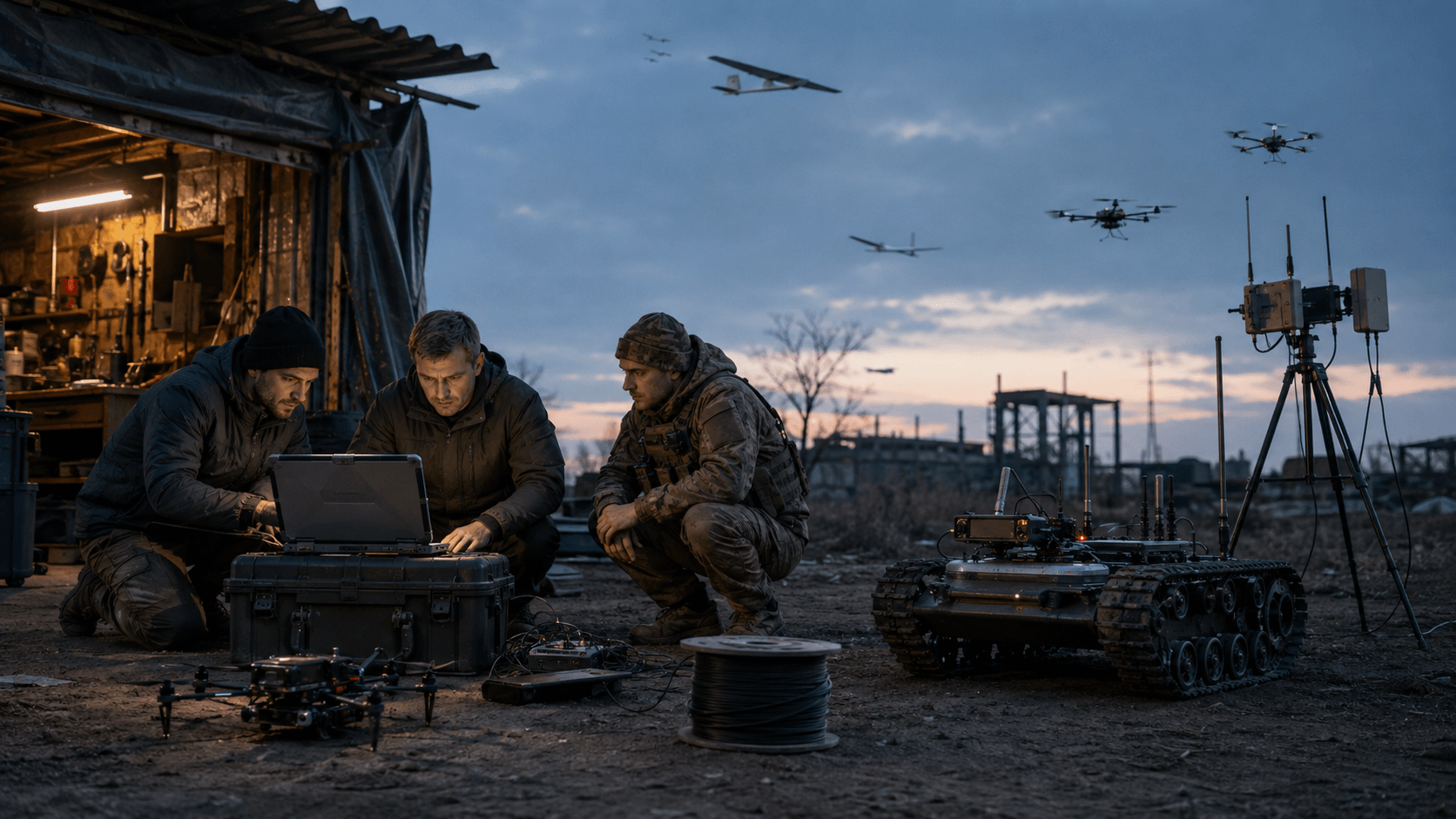
Since Russia's large-scale invasion of Ukraine in February 2022, the conflict has profoundly transformed the way a modern war is waged. A few thousand-dollar drones, artificial intelligence, satellite communications, electronic warfare, ground robots, unmanned boats and civil software now come together with tanks, combat aircraft and artillery systems, sometimes costing several million dollars.
But the real revolution may be elsewhere.
For decades, military innovation came mainly from large industrial groups working on government programs that could take 10 or 20 years to develop. In Ukraine, this logic has been partially reversed.
Civil engineers, software developers, commercial drone manufacturers, artificial intelligence specialists, video game designers and entrepreneurs who had sometimes never worked in the military field began to develop technologies capable of being tested, modified and redeployed within a few weeks.
And this technological revolution is taking place not only on the Ukrainian side. Russia has also adapted rapidly, particularly in the areas of FPV drones, electronic warfare, fibre optic drones and massive industrial production of unmanned systems.
The war in Ukraine has thus become a huge accelerator of military technologies whose consequences will far exceed this conflict.
The little drone that changed the war
One of the most spectacular transformations concerns FPV drones (First Person View).
Originally, this technology was mainly associated with aeromodelism, photography, drone racing and recreation.
The principle is simple: a camera transmits a real-time view to the driver to control an extremely handy small device.
In Ukraine, these commercial aircraft and their derivatives have gradually gained considerable military importance.
The phenomenon is mainly an economic breakdown.
A traditional military vehicle can be worth hundreds of thousands or even millions of dollars. A small drone relies largely on commercially available electronic components and can be produced in very large quantities.
The battlefield therefore becomes an environment where the sophistication of a system is no longer necessarily proportional to its price.
According to an analysis by the [Center for Strategic and International Studies] (https://www.csis.org/analysis/russia-ukraine-drone-war-innovation-frontlines-and-beyond), Russians and Ukrainians are now engaged in a real technological race in which an innovation can quickly provoke the appearance of a countermeasure, itself followed a few weeks or months later by a new adaptation.
Electronic warfare triggers a second revolution
The proliferation of drones has logically led to a parallel explosion of technologies designed to neutralize them.
Russia already had before 2022 an important experience of electronic warfare. Ukraine, for its part, has rapidly developed a multitude of detection and interference systems.
The result has become a real invisible war around the electromagnetic spectrum.
Radio communications are jammed. Satellite navigation systems can be disrupted. The frequencies used change. Manufacturers then modify their devices to maintain their capabilities.
And this confrontation gave rise to a particularly surprising technology: the FPV drone driven by fiber optics.
When Russia comes back with a fiber optic coil
This seems almost paradoxical: to circumvent some of the most sophisticated electronic systems on the battlefield, one solution is to return to a physical connection.
Instead of communicating only by radio with its operator, some drones carry behind them an extremely fine optical fiber transmitting the controls and images.
The link becomes much less vulnerable to traditional radio interference.
On this point, Russia took the initiative.
Russian forces deployed these systems on a significant scale, particularly during fighting in the Kursk region. Subsequently, Ukraine accelerated the development of its own similar solutions.
Reuters reports that [both camps now use fibre-optic drones] (https://www.reuters.com/business/aerospace-defence/russians-covertly-trained-by-china-return-fight-ukraine-sources-say-2026-05-19/), while CISS analyses consider Russia as the first player to truly push this technology on the modern battlefield.
This is a particularly revealing example of the cycle of innovation created by this war:
**Drone → interference → interference resistance → new detection method → new generation of drones. **
The process almost never stops.
Russia massively industrialises the drone war
Russia has also transformed its industry.
The Iranian Shahed, now known as "Geran" in its Russian version, is a perfect example of this development. Moscow has gradually developed a much larger domestic industrial capacity to produce long-range drones.
The apparatus itself is also evolving: communications, navigation, resistance to countermeasures and production methods are continually being modified.
Russia is also developing several families of reconnaissance and attack drones and is working towards a more systematic integration between drones, artillery and ground units.
This transformation has become significant enough to cause a change in the very structure of the Russian army.
On August 5, 2026**, Vladimir Putin appointed Denis Lyamin as head of the new Forces des systèmes sans voléte, a branch dedicated specifically to this form of war. Reuters sees this as an additional confirmation of Moscow's new strategic focus on drones.
In other words, what was still seen a few years ago as complementary equipment is now becoming a full military component.
Ukraine transforms the Black Sea with unmanned boats
However, one of the most remarkable Ukrainian innovations does not fly.
She's sailing.
Gears such as the MAGURA or the Sea Baby demonstrated that a country no longer having a conventional fleet comparable to its opponent could still exert significant pressure on naval power.
These aircraft are essentially robotic maritime platforms capable of being remotely controlled and adapted to different types of missions.
The concept has continued to evolve.
The first generations were relatively specialized. More recent versions are gradually becoming modular platforms that can provide different monitoring, interception or support functions for other unmanned systems.
The influence of this experiment is already beyond Ukraine. Technologies derived from the Ukrainian experience are now being developed in the United Kingdom, notably in the context of hybrid marine concepts, combining traditional buildings and autonomous platforms.
This could help to transform the design of future naval forces.
Next battle: drone against drone
The other major change concerns air defence.
Using an extremely expensive missile to intercept a relatively cheap drone poses an obvious economic problem.
One of the answers is therefore to fight drones with other drones.
Ukraine is now rapidly developing ** interceptors**.
The basic idea is no longer simply to improve traditional anti-aircraft systems, but to create a new layer of defence consisting of much less expensive unmanned systems.
The movement is large enough to attract foreign companies that did not even belong to the military industry before.
And that's where history becomes particularly interesting.
Terra Drone: from industrial inspection to air defence
The Japanese company Terra Drone is probably one of the best examples of this change.
The company had historically specialized in the civilian uses of drones: infrastructure inspection, mapping, oil and gas industry, construction and other commercial applications.
It was not a traditional armament manufacturer.
In March 2026, however, Terra Drone announced its official entry into the defence equipment market.
The company has partnered with the Ukrainian company Amazing Drones and has started to develop and industrialize interceptor drones intended in particular for infrastructure protection.
In May 2026, the company announced the operational deployment in Ukraine of its Terra A2 system.
A few weeks later, Terra Drone further increased its stake in the Ukrainian company.
A Japanese group specialized in the civil industrial applications of the drone has thus become, directly under the influence of the war in Ukraine, a new player in the global defence market.
It would have been difficult to imagine such a scenario a few years earlier.
Fire Point: engineers, architects and video game designers
The story of Fire Point is even more spectacular.
The Ukrainian company was born after the invasion of 2022.
Its founders and first collaborators included engineering, construction, architecture and video game design.
**They had no prior experience in the military industry. **
However, in a few years they have been one of the most important technology enterprises in Ukraine in the field of long-range systems.
In 2026, Fire Point is now working on several systems families and on an air defence project incorporating technologies from several European companies.
On 4 August 2026, [Reuters reported] (https://www.reuters.com/business/aerospace-defence/ukraines-fire-point-starts-integrate-european-tech-into-missile-defence-system-2026-08-04/) that more than a dozen European companies had concluded agreements to contribute to its project Freyja.
A virtually non-existent company before 2022 therefore works four years later with European industrialists on advanced defence technologies.
This is precisely the kind of trajectory that would have been almost impossible in the traditional military industry model.
When the civilian manufacturer didn't even want to participate
Another category is civil technologies diverted or adapted by their users.
Commercial drones are the best example.
Aircraft developed for aerial photography, inspection or recreation were used on a large scale by both sides.
The Chinese manufacturer DJI, for example, had not developed its products as military systems and publicly claimed to oppose their use in combat.
This did not prevent some of its commercial technologies from being on the battlefield.
This phenomenon reveals a major difficulty for governments: the border between civilian technology and military technology becomes extremely blurred.
Cameras, processors, artificial intelligence, electric motors, digital communications, 3D printers and navigation systems can be developed for perfectly civilian applications while possessing a dual-use ** potential**.
Artificial intelligence starts entering the loop
The next step is already underway.
When a drone is entirely dependent on radio or satellite communications, cutting off this communication can make it much less effective.
One solution is therefore to transfer more capacities directly into the device.
Image recognition, assisted navigation, field analysis and some autonomous functions can be performed locally by systems using artificial intelligence.
According to the Center for Strategic and International Studies, Ukraine had already begun acquiring thousands of drones with enhanced functions by artificial intelligence in 2024.
The technological objective is clear: to allow a platform to continue parts of its mission despite an environment where GPS and communications can become intermittent.
But this also raises a considerable ethical question:
**How far should a machine be allowed to make a decision without human intervention? **
This issue may become one of the major military, technological and legal debates of the next decade.
Robots are also starting to appear on the ground
The revolution is not just about the sky and the sea.
Unmanned land vehicles — UGV, or Unmanned Ground Vehicles — are increasingly used or experienced by both sides.
Logistics transport, evacuation, monitoring, demining and various dangerous missions can gradually be entrusted to machines.
The long-term objective is obvious: when a machine can perform a particularly dangerous task, it becomes possible to reduce human exposure.
The Ukrainian government now considers this technology important enough to make it one of the main areas supported by Brave1, its ecosystem dedicated to defence innovations.
In July 2026, the Ukrainian Ministry of Defence reported that Brave1 had awarded nearly 1,000 technology grants since its creation, with special attention now being given to robotics, artificial intelligence and new technologies.
The real revolution may be the pace of development
It would be tempting to consider drones as the main innovation of this war.
It would probably be a mistake.
Perhaps the most profound transformation concerns the speed at which innovation occurs**.
In the traditional military industry, the cycle may look like this:
**Need → specifications → call for tenders → prototype → tests → certification → production. **
It can take years.
In Ukraine, a new model was imposed under the pressure of events:
**Problem → prototype → trial → user feedback → modification → new version. **
The cycle can sometimes be measured in weeks or months.
A technology giving a temporary advantage quickly leads to a countermeasure. This countermeasure then causes a new innovation.
It is almost a form of software development applied to military equipment.
Defense giants now face startups
Lockheed Martin, RTX, Northrop Grumman, BAE Systems, Rheinmetall or Thales will obviously not disappear.
Combat aircraft, satellites, air defence systems, sophisticated radars and many other platforms will continue to require considerable industrial expertise.
But these giants now have to deal with a new ecosystem.
A startup of a few dozen engineers can design an interesting autonomous system without having a huge factory.
Commercial components may replace specific military parts.
3D printing allows quick modification of mechanical elements.
Software updates can transform the capabilities of an existing device.
Most importantly, some of the system's intelligence moves from hardware to software.
That's exactly what happened with smart phones and cars.
The same phenomenon is now occurring in the military world.
#A war where the economy becomes a technical characteristic
The Ukrainian experience also reveals something fundamental: **The price is now part of the performance of a military system. **
The question is no longer simply:
Which system has the best performance?
It becomes:
How much can we produce, how much does each use cost and how fast can we replace them?
An extremely efficient system but available in very small quantities can be less decisive than a slightly less sophisticated technology produced by hundreds of thousands.
This logic explains the immense importance taken by small drones.
It also pushes Western armies to rethink some of their acquisition methods.
The United Kingdom, for example, announced at the end of 2025 over £ 140 million in rapid investment in drones and anti-drones technologies, explicitly recognizing the lessons learned from the Ukrainian conflict. (British Government)
The battlefield becomes a technological ecosystem
What the war in Ukraine finally shows is not the disappearance of tanks, artillery or aircraft.
It's their transformation.
An isolated tank is no longer simply an armoured vehicle: it evolves in an environment filled with drones, sensors, electronic interference and permanent observation.
An artillery unit can receive information from a drone.
A drone can be detected by another sensor.
A jammer can cut off his connection.
A drone using an optical fibre can bypass this interference.
Artificial intelligence can reduce its dependence on communications.
Then an interceptor drone may appear to try to neutralize it.
Each technology drives the next.
A far wider technological legacy than conflict
Unfortunately, wars have often accelerated certain technological changes.
But Ukraine has a major feature: it takes place at a time when the civil world already has extremely sophisticated and easily accessible technologies.
Microprocessors, artificial intelligence, satellite communications, high definition cameras, digital manufacturing, free software, electric motors and commercial drones were not invented by the military.
They already existed.
What the war in Ukraine has shown is the extraordinary speed with which these technologies can be combined, adapted and transformed.
Russia has shown with massive drone industrialization, electronic warfare and fiber optic systems.
Ukraine has shown with FPV drones, unmanned naval systems, stand-alone platforms, intensive software use and an extremely decentralized startup ecosystem.
Companies like Fire Point show that a team that comes almost entirely from the civilian world can in a few years become an important player in defence.
Terra Drone shows that a foreign company specializing in civil applications can also cross the border.
And the commercial technologies used by both sides demonstrate that the historical separation between civil industry and military industry is gradually becoming much less clear.
The next military revolution, therefore, may not only come out of the secret laboratories of the great powers.
It could also start in a startup, in an agricultural drone manufacturer, in an artificial intelligence company or in front of a developer's computer which, a few months earlier, had absolutely nothing to do with defense.
And this is probably one of the most important and troubling technological teachings of the war in Ukraine.