Unitee Superman: Humanoid robot announced at nearly 46 km/h
Unitree reveals Superman, an experimental humanoid announced at 45.6 km/h and capable of a jump of 2 meters, but still far from a commercial product.
An experimental humanoid robot has just taken a new step in the race for mechanical mobility.
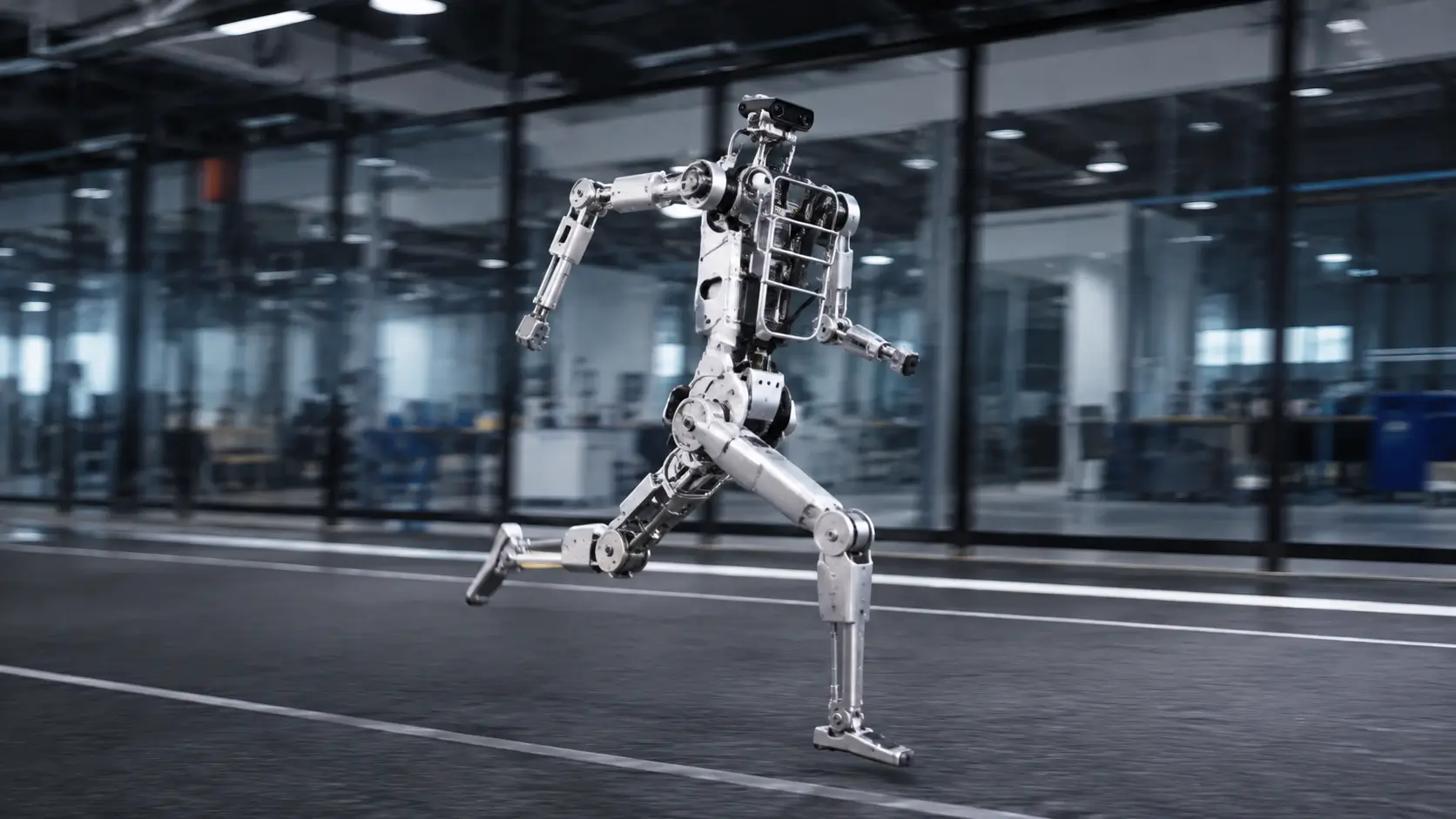
Unveiled on 17 August 2026 by the Chinese company Unitee Robotics, the prototype known as Superman would have reached a maximum speed of 12.66 meters per second, or about 45.6 km/h. Unitree also states that he can make a two-metre vertical jump from a still position.
These figures are impressive, but they come from the manufacturer and have not yet been independently verified.
Official demonstration published by Unitee
A prototype developed to repel humanoid locomotion
The Superman uses legs of about 0.85 metres and a very stripped mechanical structure. Its joints, motors, cables and carrier elements remain widely exposed, unlike robots with an envelope for factories or residences.
This design seems to prioritize lightness, power and freedom of movement rather than the appearance or manipulation of objects.
According to Reuters, Unitee developed the prototype in just over three months. The company still describes it as an ongoing work that will be improved in the coming months.
The demonstration shows the robot making a very high jump and performing acrobatic movements. It therefore confirms the existence of a functional machine, but not necessarily the exact accuracy of the announced performance.
Why running at this speed is difficult
A humanoid must constantly control its balance, the position of its centre of mass and the force exerted on the ground.
At high speed, each foot contact becomes very brief. Engines and reduction mechanisms must produce a lot of torque without adding too much mass, while the control system must correct almost instantly the movements that could cause a fall.
Jumping is another challenge. The robot must generate enough force to leave the ground, maintain a stable orientation in the air and absorb the impact on landing without damaging its joints.
The announced performances therefore suggest progress in actuators, mechanics and dynamic control. However, they do not demonstrate that Superman has a general intelligence or that he can perform useful tasks independently.
A comparison with humans to interpret carefully
Unitree presents its prototype as a machine capable of exceeding certain human limits. However, direct comparison remains difficult.
The company did not provide a detailed protocol specifying the method used to measure the speed, the duration during which it can be maintained, the type of surface, the load carried or the number of tests passed.
TechNode also points out that repeatability, test conditions and the possible presence of a safety system have not been documented.
(https://technode.com/2026/08/18/unitee-says-its-new-humanoid-reaches-12-66-m-s-and-jumps-2-meters/)
A human also makes movements with a much more complex biological body and can adapt his effort to different terrains. A speed peak obtained in a laboratory therefore does not mean that a robot could track a person over a long distance or in an unpredictable environment.
What the demonstration doesn't prove yet
Unite n has provided no data on battery range, total weight, electrical power, load capacity or fall resistance.
It is also not known whether the robot can run on gravel, a slope, a slippery surface or an irregular soil. Its ability to detect obstacles and change its trajectory at high speed has not been demonstrated.
No information was provided on his hands, his handling accuracy or the tasks he could perform. The prototype currently appears to serve as a research platform on locomotion rather than as a multi-purpose robot.
Prices and availability in Canada
Unitree did not announce any prices, pre-orders and production schedules for Superman.
The robot is not marketed in Canada and no applications for Canadian registration have been made public. It would therefore be premature to estimate its cost or availability.
The prices of the other Unite robots do not make it possible to estimate Superman's because its configuration, engines, computer system and commercial vocation are not known.
Limits or Considerations
The performance of 12.66 meters per second and the jump of two meters are claims of the manufacturer. They must be reproduced in accordance with an independent protocol.
The video does not evaluate endurance, reliability, energy consumption or safety near humans.
The timing of the announcement also deserves to be mentioned. Unitree presented Superman a few days before his scheduled entry to the Shanghai Stock Exchange. This proximity does not automatically render the demonstration invalid, but it gives the company a clear interest in attracting attention.
Finally, an extremely fast robot can pose new safety problems. A heavy machine moving close to 46 km/h would require reliable braking, detection and emergency shutdown systems prior to any public use.
Conclusion
Superman shows how far humanoid locomotion can go when a robot is built for speed, power and agility.
The prototype is a remarkable mechanical demonstration, but it does not yet represent a self-employed worker or a domestic assistant. Its autonomy, repeatability, safety and practical usefulness remain to be demonstrated.
For now, the most important achievement is not that a robot can replace a human. It is that an experimental biped machine now seems capable of achieving dynamic movements that would have seemed unrealistic only a few years ago.