
DJI Dock 4 exchanges its drone battery in 25 seconds
The DJI Dock 4 automatically exchanges its drone battery in 25 seconds, but its price and Canadian eligibility remain to be confirmed.
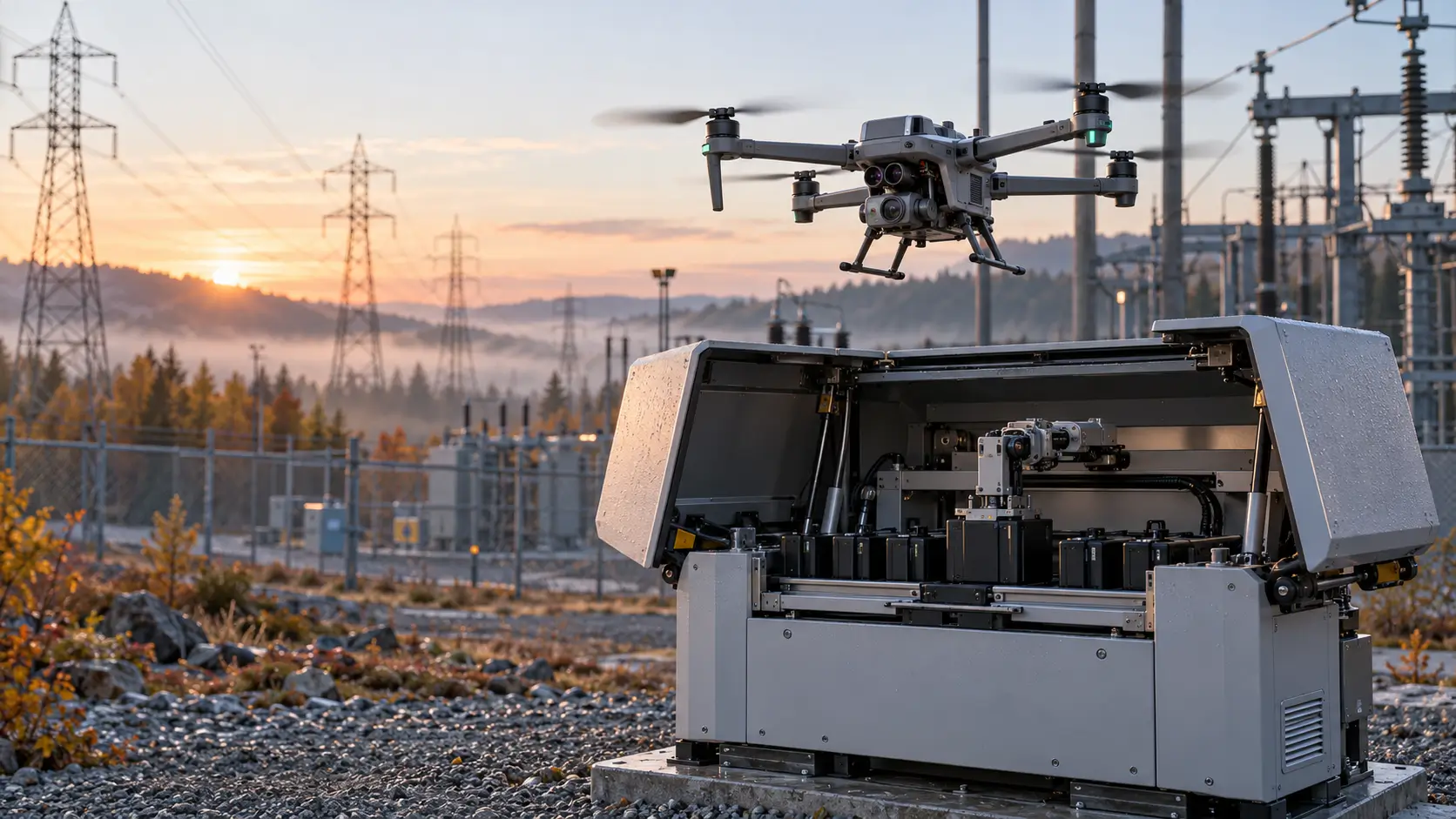
An inspection drone can fly almost an hour, then remain immobilized for a good amount of time to recharge its battery. DJI wants to reduce this wait to a few seconds with Dock 4, an external station that automatically removes the battery from the new 5TD Matrix and replaces it with another already loaded.
Launched on 14 October, the system targets emergency services, industrial sites, mines and infrastructure inspections. It is offered by DJI Enterprise resellers, including Canadian integrators, but its public price and eligibility for several regulated transactions in Canada remain to be confirmed.
An automatic replacement rather than a recharge
The DJI Dock 4 contains up to three replacement batteries and can load two simultaneously. After landing, one internal mechanism removes the battery from the drone and installs another. DJI announces an exchange in less than 25 seconds, measured between the closure of the lid and the end of the operation.
According to DroneXL, the complete cycle between landing and a new take-off would take about 45 seconds. The media also reports that a battery increases from 15% to 95% in 27 minutes. These figures are derived from the conditions and specifications of DJI; no extended independent test has yet validated the rate in cold, rain or after hundreds of cycles.
The station weighs 66 kg without its batteries or the drone. It is IP56 certified and its predicted operating range ranges from -40 to 50 °C, making it theoretically suitable for Canadian winters. However, this does not guarantee the actual efficiency of the mechanism with frost, blowing snow or ice accumulation.
A specialized drone for inspection and response
The Dock 4 only works with the new 5TD Matrix. This 2.6 kg drone offers, according to the manufacturer, up to 59 minutes of flight under laboratory conditions and an announced maximum speed of 21 m/s, or approximately 76 km/h.
Its sensor block includes three 50 MPx cameras, a thermal camera of 1,280 x 1,024 pixels and a laser telemeter of up to 3 km in favorable conditions. LiDAR, a millimetre wave radar and real-time detection functions for 17 categories of objects complete the set. These capabilities could help identify a hot spot, inspect a tower, or quickly obtain an overview before the teams arrive on the ground.
However, the system requires a DJI O4 ground station. The Matrix 5TD is not designed to be operated manually with an ordinary radio control. Missions go through FlightHub 2, offered in a public cloud or local installation. DJI indicates that data from users outside China are hosted on AWS in the United States or Europe when the public service is used; organisations with data residency requirements will have to examine the local option and its costs.
Prices, availability and Canada
DJI has published no prices or ranges for Dock 4. Canadian resellers such as SpeedyDrone and Remote Robotic invite organizations to request a bid. A complete installation can include station, Matrix 5TD, O4 station, batteries, connectivity, FlightHub 2, installation, training and support.
The final price can therefore vary according to configuration, retailer, software, services, promotions and region. Neither does a Canadian page or a bid prove that a system is immediately in stock.
On the day of launch, the RPAS Centre indicated that Matrix 5TD was not yet on the Canadian list of drones with a safety assurance statement. Transport Canada states that such a declaration is necessary for certain advanced or complex operations. Automated missions with no direct visibility may also require a complex level 1 certificate, a SATP operator certificate or, depending on the scenario, a specialized air operations certificate.
Limits or Considerations
The announced speed of exchange is not yet confirmed by an independent test. The reliability of the mechanism remains to be measured under Canadian conditions, battery wear, noise, maintenance costs and parts availability.
Automation does not remove human responsibilities. An organization must plan trajectories, manage authorizations, protect data, monitor weather, and provide a procedure for unexpected loss of communication or landing.
Conclusion
The Dock 4 replaces a long recharge with a nearly immediate battery feed. For an emergency team or infrastructure operator, this difference could turn an occasional drone into a tool that is actually available continuously.
The promise is mechanically credible, but it still needs to pass three tests: field reliability, the total cost of a facility and authorization of each type of mission in Canada. The equipment, site and regulatory framework must be validated together before purchasing.