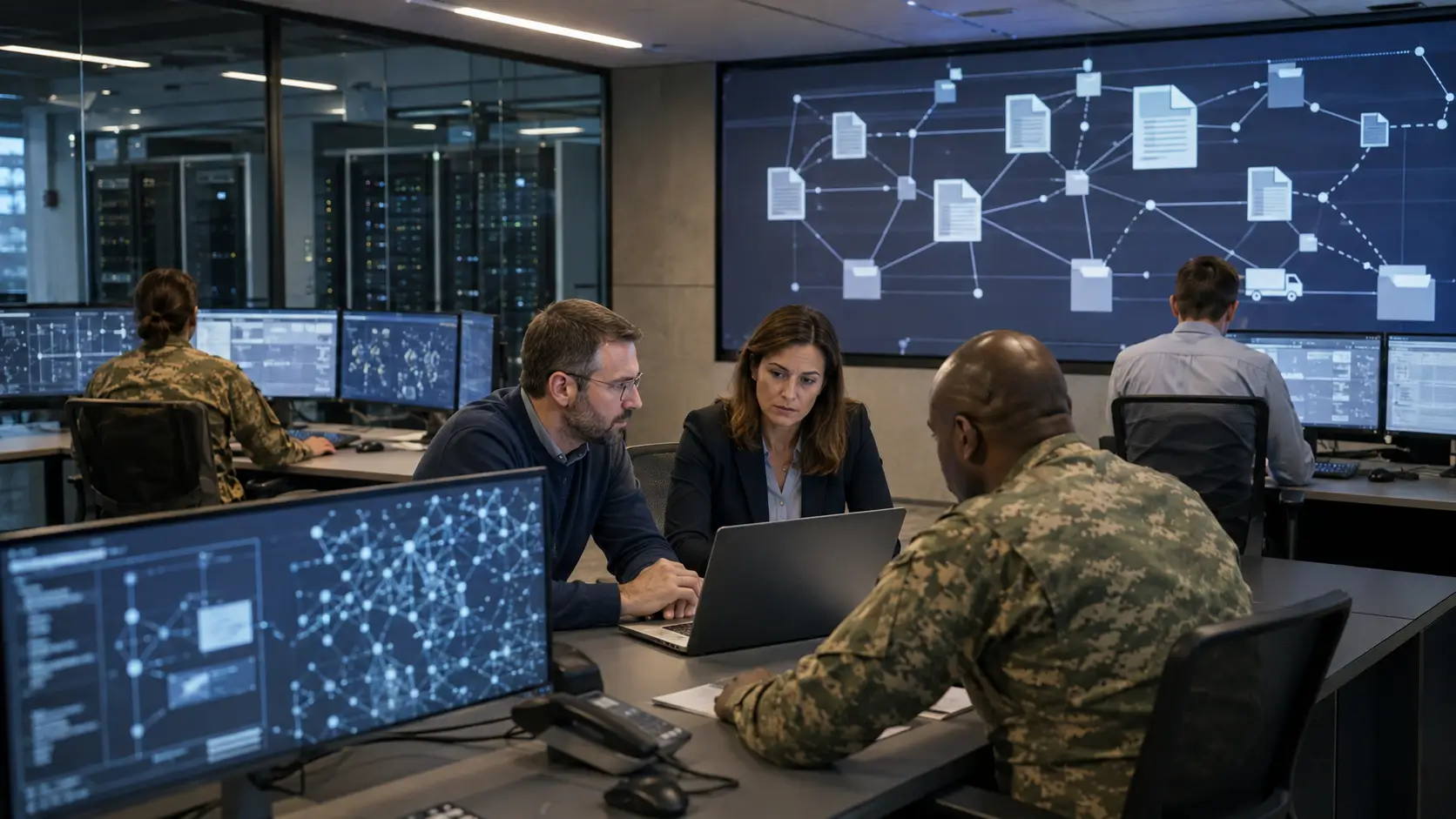
From military radios to artificial intelligence: the technological shift of the Canadian Armed Forces
Discover how the Canadian Armed Forces are modernizing their telecommunications, computer systems, cybersecurity and AI.
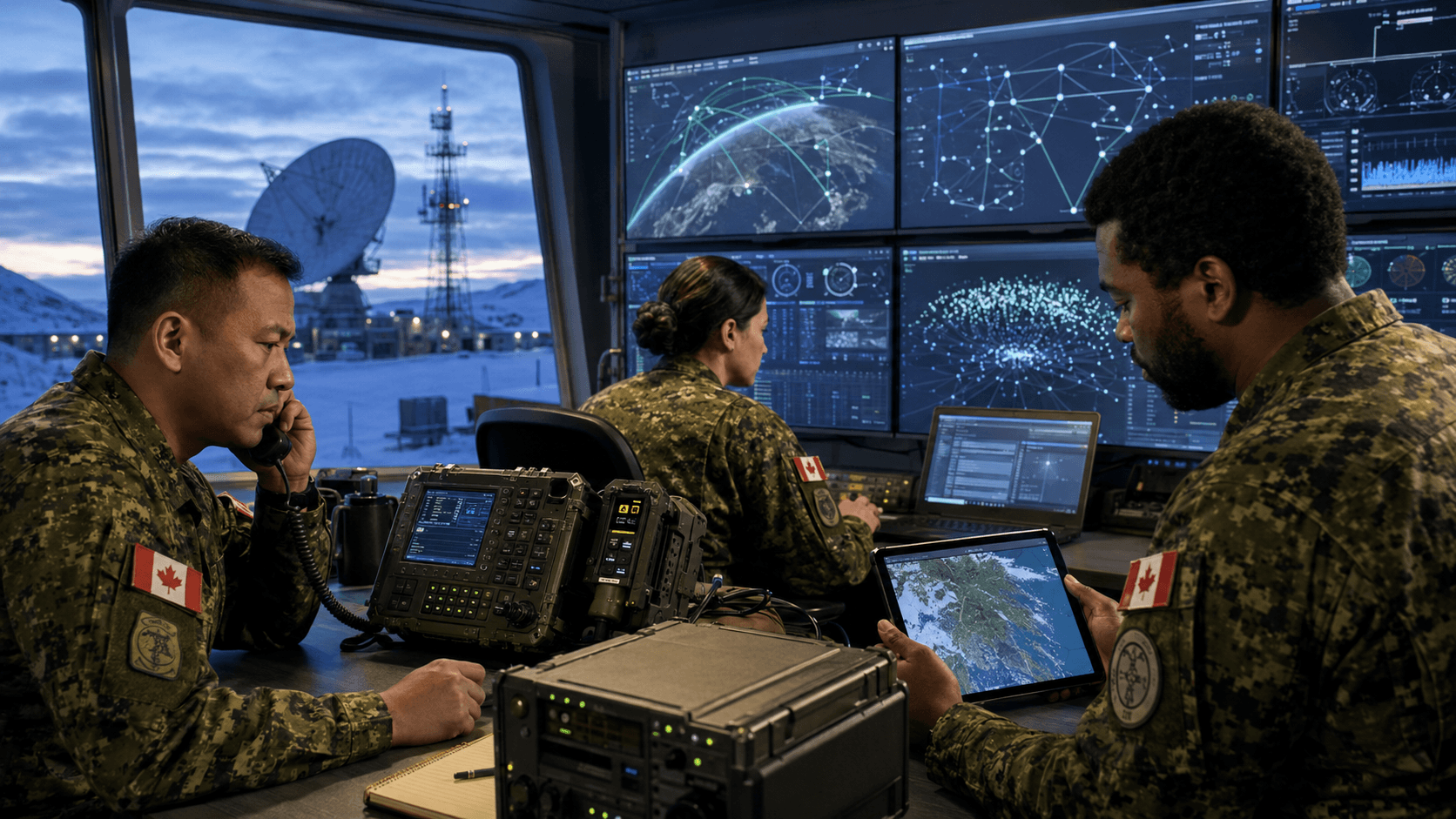
The Canadian Armed Forces are no longer modernizing solely by purchasing new vehicles, ships, and aircraft.
A much less visible transformation is underway in telecommunications networks, information systems, cloud computing, cybersecurity, data management, and artificial intelligence.
This transformation has become essential.
A modern military force must be able to collect information, transmit it securely, combine it with other data, and make it rapidly available to those responsible for making decisions.
Communications, software, and data are therefore no longer simply administrative services. They are becoming operational capabilities as important as many traditional pieces of military equipment.
Since 2022, and particularly since the launch of its first artificial intelligence strategy in 2024, the Department of National Defence has introduced several initiatives intended to accelerate this transition.
The progress is real, but modern systems must still coexist with aging networks, isolated platforms, slow procurement processes, and a significant shortage of specialists.
The digital modernization of the Canadian Armed Forces is not simply about replacing old computers. It is transforming how Canada observes, communicates, plans, and conducts military operations.
Situation as of August 2026.
A modern military must first become a digital organization
The Canadian Armed Forces Digital Campaign Plan sets out a clear ambition: enabling military personnel to sense, understand, decide, and act at the speed of operations.
This transformation is expected to improve international missions, search and rescue, disaster assistance, territorial surveillance, and the defence of North America.
The vision is based on several elements:
- secure and resilient networks;
- reliable and accessible data;
- systems compatible with those of Canada’s allies;
- digital tools that can be used in the field;
- improved awareness of personnel and equipment availability;
- less fragmented administrative processes;
- faster decision-making.
The objective is therefore not simply to digitize existing methods.
It is to change the way the organization works so that information can circulate among bases, headquarters, deployed units, government partners, and allied forces.
This transformation is largely coordinated by the Digital Services Group, created in 2024 through the reorganization of National Defence’s information technology and digital transformation functions.
The group is responsible for several essential areas:
- data and analytics;
- information management;
- digital products and services;
- enterprise resource planning modernization;
- artificial intelligence;
- the organization’s digital infrastructure.
The creation of this structure demonstrates that technology is no longer considered a simple support function. It is becoming a central component of operational readiness.
Replacing infrastructure that has become outdated
A significant portion of this transformation remains very fundamental: outdated systems must first be replaced or modernized.
In its 2024–25 Departmental Results Report, National Defence stated that it had replaced more than 40,000 telephone lines, improved bandwidth at several bases, and deployed new secure collaboration environments.
The department introduced, among other things:
- secure Microsoft 365 and SharePoint environments;
- new mobile access methods;
- context-aware access controls;
- additional encryption mechanisms;
- centralized application-monitoring tools;
- new external collaboration capabilities.
Network infrastructure was also modernized at approximately 40 Canadian Army locations, including bases, garrisons, and armouries.
These improvements are intended to enable the use of cloud services and modern tools in facilities that were not always designed for today’s digital requirements.
The results, however, also reveal how much work remains.
During the 2024–25 fiscal year, the Canadian Army planned nine Wi-Fi installations at various facilities. Only two were completed during that period because of the complexity of the work.
Digital modernization may appear fast when a new application is announced. It becomes much slower when wiring must be replaced, buildings must be upgraded, security requirements must be met, and new networks must be integrated into aging infrastructure.
From office telephones to operational networks
In a business, a network outage can slow operations.
In a military organization, unavailable or compromised communications can directly affect an operation.
The Canadian Armed Forces must therefore develop networks capable of functioning in environments that are much more demanding than those faced by civilian organizations.
These communications must be able to withstand:
- long distances;
- extreme weather conditions;
- infrastructure failures;
- interception attempts;
- electronic jamming;
- cyberattacks;
- the destruction or loss of equipment.
Security cannot simply be added after a system has been designed.
It must be built into the system from the beginning.
The 2026–27 Departmental Plan therefore calls for cybersecurity and emissions-security considerations to be incorporated at the design stage of new digital and information and communications technology investments.
Satellite communications become essential in the Arctic
Canada’s territory presents an exceptional telecommunications challenge.
The Canadian Armed Forces must maintain communications across an immense area, including northern regions where terrestrial infrastructure is limited or nonexistent.
Satellites are therefore taking on an increasingly important role in Canada’s military strategy.
In November 2024, the CAF announced that it had achieved initial operational capability under the Tactical Narrowband Satellite Communications – Geosynchronous Project.
This system is intended to provide secure beyond-line-of-sight communications, particularly for voice services and applications using small quantities of data.
Its coverage is expected to support Canadian military personnel deployed almost anywhere in the world, including northern regions.
In December 2025, the government also announced a partnership with Telesat and MDA Space under the Enhanced Satellite Communications Project – Polar.
The project is intended to provide secure narrowband and wideband military communications in the Arctic.
These communications are expected to support:
- sovereignty operations;
- northern surveillance;
- search and rescue;
- continental operations;
- cooperation with NORAD;
- communications between deployed units and command centres.
An initial $2.92-million contract was awarded for engineering work and options analysis. The complete project is expected to lead to much larger investments.
Canada also plans to invest more than $5 billion in a global satellite communications system intended to connect CAF operations around the world.
Modernizing NORAD also means modernizing data
The modernization of the North American Aerospace Defense Command, better known as NORAD, does not depend solely on acquiring new radars.
In 2022, Canada announced a $38.6-billion investment over twenty years to modernize its contribution to NORAD.
A significant portion of this investment is directed toward systems capable of collecting, transmitting, and analyzing information originating in the North.
Canada’s future Arctic Over-the-Horizon Radar will be able to detect certain objects at much greater distances than conventional radar systems.
However, a sensor has real operational value only when its data can be:
- collected;
- secured;
- transmitted;
- combined with other sources;
- analyzed;
- rapidly presented to commanders.
NORAD modernization is therefore also an enormous telecommunications, computing, and data-fusion project.
The initial capability of the Arctic Over-the-Horizon Radar is currently expected in December 2029.
Tablets and mobile phones reach the field
Digital transformation is also beginning to reach military personnel directly.
During the 2024–25 fiscal year, the Canadian Army deployed approximately 500 tablets and 700 mobile phones through the Cloud Tactical Awareness Kit.
These devices allow Regular and Reserve Force personnel to access a shared operational picture.
The system was also used to facilitate coordination with certain public-safety partners during domestic operations.
This approach illustrates an important change.
In the past, military command systems often consisted of specialized platforms that were extremely expensive and difficult to update.
New architectures increasingly attempt to use:
- mobile devices;
- cloud services;
- evolving software;
- mapping interfaces;
- shared data;
- more frequent updates.
This does not mean ordinary commercial devices can replace every military system.
Security classifications, resistance to jamming, and operational requirements remain different.
Military forces are nevertheless attempting to benefit from some of the civilian sector’s advantages: simplicity, mobility, availability, and development speed.
The military cloud becomes strategic infrastructure
Cloud computing occupies a central place in this transformation.
The government has allocated resources to a Joint Defence Cloud Program responsible for maintaining existing cloud capabilities and adopting new ones.
The use of cloud infrastructure is expected to make it possible to:
- access data more quickly;
- deploy applications without rebuilding the entire infrastructure;
- facilitate work between different organizations;
- improve service continuity;
- operate analytical tools;
- support the development of artificial intelligence.
A military environment, however, cannot simply transfer all of its information to a commercial provider.
Data may be unclassified, protected, secret, or directly related to military operations.
National Defence must therefore create several environments capable of operating at different security levels, including locations where connections to major data centres are limited.
MapleStack: a sovereign digital platform
One of the most important projects announced for 2026–27 is called MapleStack.
National Defence describes it as a suite of integrated, AI-powered technologies intended to support modern military operations across:
- unclassified environments;
- classified environments;
- edge environments;
- connected or temporarily disconnected environments.
The project is supported by an initial investment of $33.5 million.
MapleStack is expected to support:
- a Zero Trust security architecture;
- interoperability with allies;
- data processing in deployed environments;
- the use of Canadian technologies;
- the creation of sovereign artificial intelligence capabilities.
The word “sovereign” is particularly important.
Canada wants to avoid having all of its critical digital capabilities depend on platforms, data, or models controlled entirely by foreign companies.
In practice, complete technological independence would be difficult to achieve. National Defence will continue using commercial technologies and cooperating with allied countries.
The objective is instead to retain greater control over military data, system architecture, and essential components.
Transforming data before artificial intelligence can be used
Artificial intelligence is only useful when it can access sufficiently reliable data.
Large government organizations often possess information distributed across systems that do not always communicate properly with one another.
The same objects may be described using different formats. Some data may be incomplete, duplicated, or difficult to locate.
National Defence is therefore working on several initiatives intended to strengthen this foundation.
Data Ready Defence
The Data Ready Defence initiative is intended to unify access to data across the organization.
Its objective is to create a secure and modular integration layer allowing authorized systems to access and use information without immediately eliminating every existing platform.
A data-integration platform
National Defence is also developing an integration platform intended to connect different sources and improve interoperability.
An enterprise data catalogue
An organizational catalogue is expected to provide a better understanding of what data exists, where it is located, who is responsible for it, and under what conditions it can be used.
Standardization
Common standards are required so that information concerning personnel, equipment, maintenance, inventories, and operational readiness can be compared and analyzed properly.
This work is less spectacular than an autonomous robot or military drone.
It is nevertheless an essential condition for almost every other innovation.
Before becoming an organization powered by artificial intelligence, National Defence must become an organization capable of understanding and governing its own data.
Canada’s first military artificial intelligence strategy
In March 2024, the Department of National Defence and the Canadian Armed Forces released their first Artificial Intelligence Strategy.
The stated objective is to make Defence an AI-enabled organization by 2030.
The strategy is based on five main lines of effort:
- identifying and deploying the necessary capabilities;
- developing a culture that supports innovation;
- ensuring ethical, legal, inclusive, safe, and trusted use;
- recruiting and training the necessary personnel;
- strengthening partnerships with allies, universities, and industry.
Artificial intelligence could be used in several areas:
- analyzing large quantities of data;
- cybersecurity;
- predictive maintenance;
- logistics;
- anomaly detection;
- image recognition;
- surveillance;
- planning;
- resource management;
- translation;
- document research;
- decision support.
The government nevertheless emphasizes that artificial intelligence should improve the work of military personnel rather than eliminate human responsibility.
An Artificial Intelligence Centre for Defence
National Defence created an Artificial Intelligence Centre to coordinate initiatives that had previously been distributed among several organizations.
The Centre is expected to:
- develop technical standards;
- establish governance mechanisms;
- support pilot projects;
- provide secure development environments;
- facilitate access to specialists;
- accelerate testing;
- develop risk-assessment methods;
- support procurement;
- establish partnerships with industry and universities.
The 2024–25 Departmental Results Report indicates that the Centre had been established and staffed within its allocated resources.
For 2026–27, National Defence plans to move more clearly from design to delivery.
The department intends to:
- launch its AI Ethics Framework;
- implement a governance model;
- recruit specialists;
- create standardized and secure AI workspaces;
- establish a risk-management framework;
- accelerate testing in operational environments;
- transform selected prototypes into usable tools.
A Canadian military AI capability already demonstrated to NATO
One of the most interesting examples comes from the Canadian Armed Forces Cyber Command.
Five members of 33 Signal Regiment began developing a Canadian artificial intelligence tool in January 2025 to support cyber-threat analysis and operational awareness.
The capability was later demonstrated during NATO’s Coalition Warrior Interoperability Exercise 2025, or CWIX 2025, in Poland.
The tool is intended to assist in identifying indications and warnings associated with cyber activity.
This example is notable for two reasons.
First, the project was not developed by an enormous industrial team, but by a small group of military personnel with specialized expertise.
Second, it demonstrates that military artificial intelligence is not limited to autonomous weapon systems. It can also help sort information, identify trends, and improve understanding of a complex digital environment.
Cyberspace becomes a true operational domain
On September 26, 2024, the Canadian Armed Forces officially established the Canadian Armed Forces Cyber Command, or CAFCYBERCOM.
This command brings several capabilities under a single authority:
- cyber operations;
- signals intelligence;
- joint electronic warfare;
- cyber-force development;
- coordination of defensive and offensive capabilities.
It works closely with the Communications Security Establishment, as well as with partners in NORAD, NATO, and the Five Eyes alliance.
The command’s creation responds to a simple reality: an adversary can now disrupt a military organization without directly attacking a base or vehicle.
An adversary may attempt to:
- steal intelligence;
- compromise accounts;
- interrupt services;
- manipulate data;
- disrupt a supply chain;
- jam communications;
- damage confidence in military systems.
Cybersecurity is therefore no longer limited to protecting administrative computers.
It must protect the entire ecosystem connecting personnel, sensors, vehicles, bases, suppliers, and commanders.
Administrative computing also affects military readiness
A military digital transformation does not concern operations alone.
The availability of a vehicle, ship, or aircraft also depends on information systems capable of tracking:
- spare parts;
- inspections;
- repairs;
- inventories;
- contracts;
- technicians;
- costs;
- maintenance schedules.
National Defence is therefore continuing the DefenceX program, which is intended to modernize its enterprise resource planning system by migrating to the SAP S/4HANA platform.
The program is expected to transform several functions:
- finance;
- the defence supply chain;
- equipment procurement;
- maintenance;
- engineering;
- real property;
- program management;
- reporting;
- predictive analytics.
Improved data quality could make it possible to determine more quickly which equipment is available, which components must be ordered, and which problems may immobilize an entire fleet.
Administration and military operations are therefore much more closely connected than they may appear.
Significant investments, but results will take time
In June 2025, the government announced $560 million to strengthen the digital foundations of National Defence and the Canadian Armed Forces.
These investments are expected to:
- increase resilience against cyber threats;
- better protect information;
- use data more effectively;
- modernize infrastructure;
- support a more digitally capable workforce.
Money alone, however, will not automatically solve every problem.
The transformation also requires:
- specialists;
- governance rules;
- coherent architecture;
- improved project management;
- faster procurement processes;
- training;
- a culture that supports change;
- close cooperation with allies.
The challenge of recruiting technology specialists
The Canadian Armed Forces must recruit specialists in fields where the private sector often offers high salaries and highly flexible working conditions.
The required profiles include:
- cybersecurity specialists;
- network engineers;
- cloud-computing specialists;
- data architects;
- software developers;
- data scientists;
- artificial intelligence engineers;
- satellite-communications specialists;
- electronic-warfare technicians.
National Defence must also train personnel who are already serving.
The objective is not to turn every soldier, sailor, or aviator into a programmer.
Users must nevertheless understand the capabilities and limitations of the digital tools that increasingly influence their decisions.
Interoperability with allies
Canada rarely conducts major military operations entirely on its own.
Its systems must operate with those of the United States, NORAD, NATO, and the Five Eyes alliance.
This interoperability represents a considerable technical challenge.
Partners must be able to exchange information without compromising their networks or disclosing intelligence to unauthorized users.
Data formats, classification levels, identification systems, and digital architectures must be sufficiently compatible.
This is one of the reasons Canada participates in exercises such as CWIX and Cyber Coalition.
These exercises make it possible to verify whether systems can actually communicate in a multinational environment, beyond presentations and technical documentation.
The risks of military artificial intelligence
The use of artificial intelligence in the military domain raises important questions.
A system may produce a convincing answer while still being incorrect.
A model may reproduce biases contained in its training data.
Information may have been manipulated by an adversary.
A tool developed for an administrative environment could become dangerous if used without proper validation during an operation.
National Defence must therefore be able to assess:
- data quality;
- the reliability of results;
- bias;
- decision traceability;
- the cybersecurity of AI models;
- the possibility of manipulation;
- human responsibility;
- compliance with Canadian and international law.
The future AI Ethics Framework and governance model are intended to address some of these concerns.
The fundamental principle must remain clear:
A machine may assist a decision, but it must not eliminate human responsibility.
A promising transformation that remains incomplete
The Canadian Armed Forces have completed several important steps since 2022.
They now have:
- a digital transformation plan;
- a Digital Services Group;
- an artificial intelligence strategy;
- an Artificial Intelligence Centre;
- a command dedicated to cyberspace;
- new satellite projects;
- mobile platforms deployed in the field;
- data-integration and standardization programs;
- military cloud-computing projects;
- a modernization program for administrative systems.
The direction is therefore much clearer than it was previously.
Modernization, however, will not be completed simply because new organizational structures have been created.
Replacing legacy systems, installing networks, training personnel, and integrating data will still require several years.
The results must also be measured under real operating conditions.
A digital platform has genuine military value only if it remains available, secure, and usable in difficult environments.
The next military force will also be a network
For many years, military power was primarily measured by the number of soldiers, ships, aircraft, and vehicles.
These elements remain essential.
Their effectiveness, however, increasingly depends on the network connecting them.
A sensor must transmit its data.
A military unit must be able to communicate.
An information system must present a coherent picture.
An artificial intelligence tool must be able to analyze reliable information.
A commander must receive that information quickly enough to make a decision.
The next generation of the Canadian Armed Forces will therefore not consist solely of new equipment.
It will be an enormous system connecting people, data, satellites, sensors, software, and operational platforms.
Technology will not replace military personnel.
However, military personnel capable of understanding and using that technology will have a considerable advantage over those who have not completed their transformation.
For Canada, the challenge is now to convert announced strategies, organizational structures, and investments into capabilities that are genuinely available.
Sources
-
Department of National Defence — Canadian Armed Forces Digital Campaign Plan
-
Department of National Defence — 2024–25 Departmental Results Report
-
Department of National Defence — Assessment of the Defence Resource Business Modernization Programme
-
Department of National Defence — Canadian Armed Forces Digital Capabilities funding
-
Canadian Army — Inflection Point 2025: Canadian Army Modernization