Globalstar 2-R: eight satellites integrated in Montreal take flight
Eight Globalstar satellites built in Montreal join the orbit to strengthen direct communications to aircraft and IoT services.
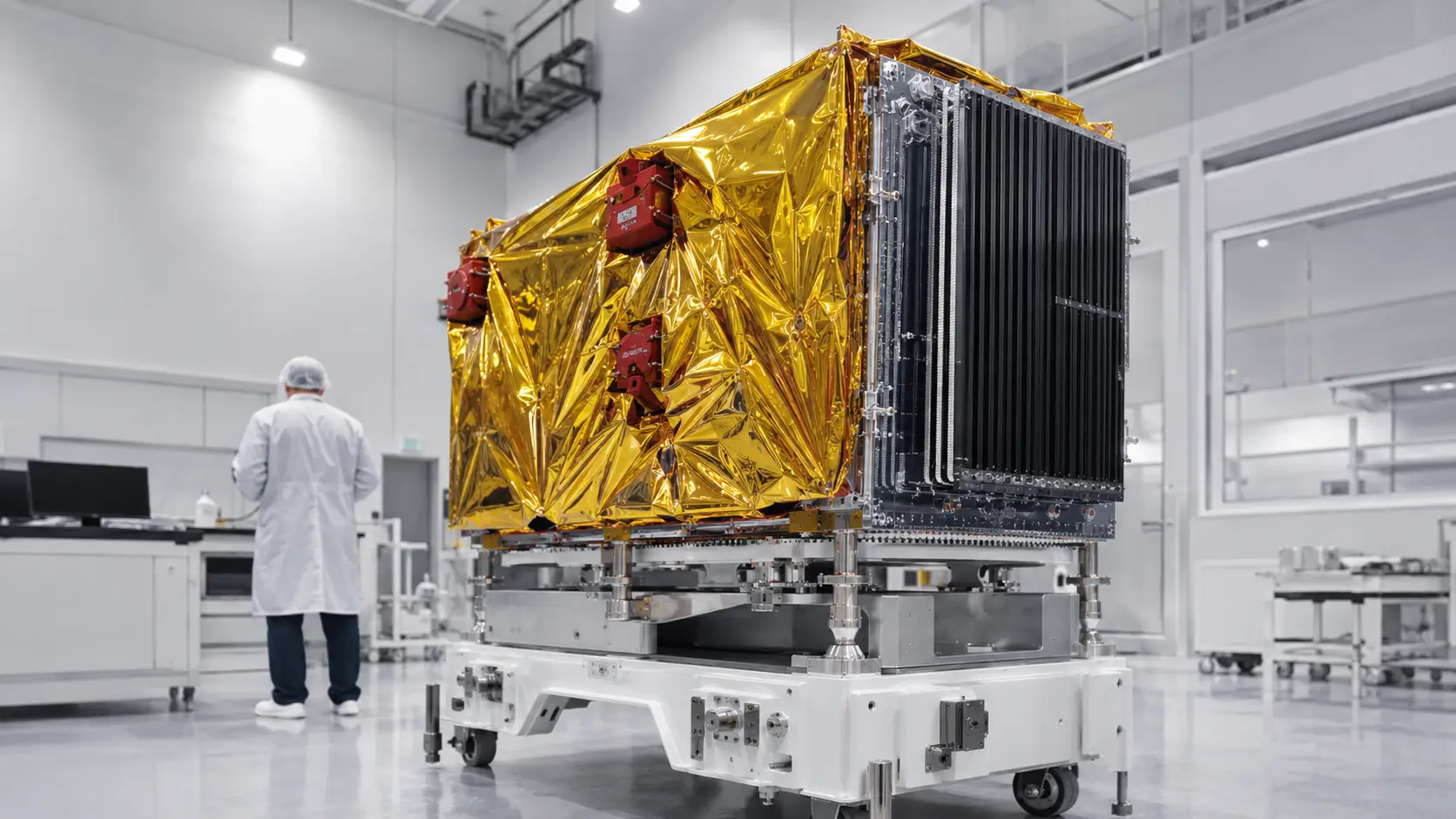
Eight new telecommunications satellites have just joined the low terrestrial orbit after being integrated and tested in Montreal by MDA Space.
The launch took place on 15 August 2026 at 2112 Eastern Time from Cape Canaveral, Florida. A SpaceX Falcon 9 rocket placed the aircraft in orbit, now starting their testing and commissioning period.
(https://mda.space/article/mda-space-satellites-for-globalstar-successfully-launched)
Renewing a constellation already in service
Satellites are part of the Globalstar 2-R programme to renew Globalstar's low-orbiting telecommunications constellation.
It is therefore not a brand new network or a service that becomes immediately accessible to the public. The aircraft must gradually replace part of the aging satellites and ensure continuity of current services.
In particular, Globalstar operates direct communications with certain mobile devices as well as Internet of Things services. Its network is also used for various accessible satellite functions when cellular and Wi-Fi networks are missing.
Satellite emergency services on some Apple devices include Globalstar infrastructure. This function allows short messages to be transmitted to emergency services from a location with a sufficiently clear view of the sky.
Explication of Apple's satellite emergency service
The arrival of new satellites aims first to maintain the availability and reliability of the network. MDA Space did not announce a new function for consumers directly following this launch.
A collaboration between Montreal and California
The programme comprises 17 satellites of about 500 kilograms each.
Rocket Lab designed and manufactured their platforms from an adapted version of its Lightning architecture. These platforms include the structure, solar panels, reaction wheels, some avionics, flight software, telemetry, tracking and control radios.
MDA Space acts as programme manager. The company has developed the telecommunications payload and completed the final assembly, integration and testing of satellites in its Montreal facilities.
Technical description provided by Rocket Lab
This division of labour illustrates the complexity of modern space manufacturing. One company can design the basic platform, while another develops the payload, assembles the subsystems and checks that the set will withstand launch and orbital conditions.
For MDA Space, they are the first low-orbit telecommunications satellites delivered by the company as the contractor of a commercial constellation.
The eight satellites responded after their deployment
According to Rocket Lab, ground crews established communications with each of the eight satellites. The company claims that they operate normally and generate electricity.
This confirmation is an important step, but it does not yet mean that the aircraft is fully operational.
Satellites must now undergo a series of orbital verifications. In particular, the teams will examine their power supply, communications, orientation and operation of their various subsystems prior to their integration into the active network.
The other nine satellites commanded by Globalstar are in the final stages of integration at MDA Space. No specific launch date was announced in the communiqué of 16 August.
A launch accompanied by a record for SpaceX
The Globalstar mission also contributed to a record pace for SpaceX.
Only 38 and a half minutes after Cape Canaveral took off, another Falcon 9 rocket left California with a payload from the US Space Force. According to Spaceflight Now, this is the shortest interval ever achieved between two orbital launches by the same company.
The first floor used for the Globalstar mission was on its fourteenth flight. He returned to land near his launch site about eight minutes after take-off.
Prices and availability
Globalstar 2-R satellites are not products sold directly to consumers.
Rocket Lab indicates that its initial contract with MDA Space for the 17 platforms has a value of US$143 million. However, this amount does not represent the total cost of the program or the full individual price of a satellite.
The rates and availability of services based on Globalstar depend on device manufacturers, suppliers, packages, features offered and supported regions.
Limits or Considerations
The launch is successful, but the commissioning is still underway. Additional coverage, reliability and capacity can only be confirmed after orbital testing.
These devices renew an existing constellation. They should not be confused with a new constellation of broadband Internet access comparable to Starlink.
Finally, Globalstar and its partners do not guarantee that each satellite function will be available on all devices or in all regions. Compatibility depends on hardware, software, trade agreements and regulatory authorities.
Conclusion
The launch of the first eight Globalstar 2‐R satellites represents a concrete achievement for the Quebec space industry.
The platforms were built by Rocket Lab, while MDA Space developed their payload and completed their final assembly, integration and testing in Montreal.
Their role is less spectacular than that of an entirely new constellation, but it remains essential: to ensure the continuity of a network that already links mobile devices and connected objects when terrestrial infrastructures are not accessible.