IA crosses the threshold of reality: the week when agents act
Discover the world's advances this week: autonomous agents, robotics, voice assistants, education and new regulations.
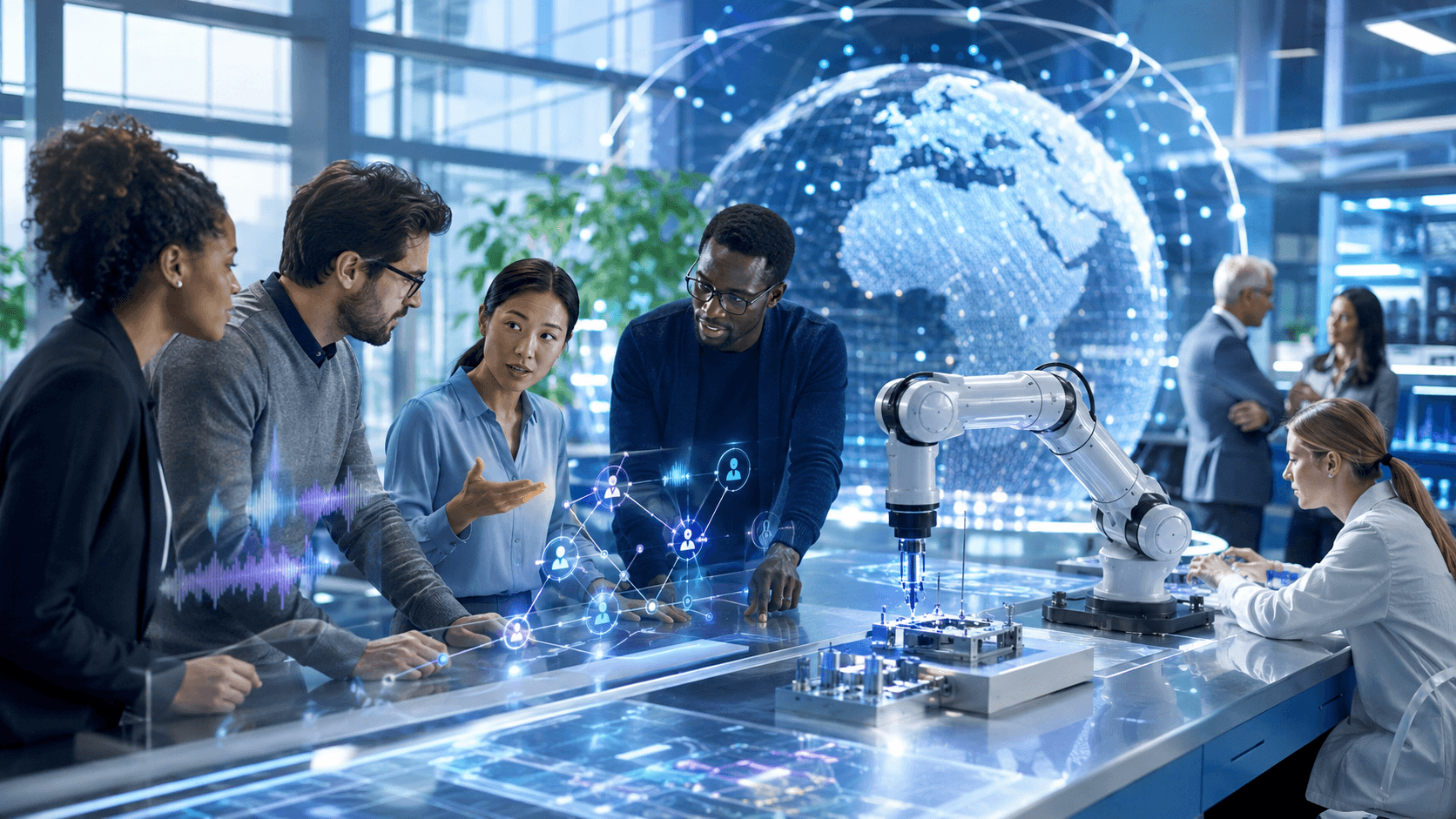
*An overview of the world's major advances in artificial intelligence observed at the beginning of the week of August 3, 2026. *
Artificial intelligence is no longer simply producing text, images or lines of code. The announcements published this week confirm a much deeper change: the AI is gradually evolving from a tool that is being consulted towards a system capable of understanding a context, using multiple resources and performing a succession of actions.
This transition to more autonomous agents now involves programming, education, robotics, voice interfaces and even economic development policies. At the same time, governments are beginning to impose rules to make these technologies more transparent.
Much more natural voice conversations
One of the major technical advances of the week is real-time voice interactions.
Traditional voice assistants usually work in turn: the user speaks, the system waits for the end of the sentence, analyses the demand, and then generates a response. This architecture often causes artificial silences and awkward interruptions.
OpenAI presented a new architecture for its GPT‐Live system on August 3. It is based on a "full duplex" vocal model, capable of listening and speaking simultaneously. The system can thus maintain a continuous conversation while using, in the background, more powerful models when a search, in-depth reasoning or the use of a tool becomes necessary.
The architecture also separates the audio stream from other operations. A slow search or a complex task can therefore continue without interrupting the conversation. Optimizations to the WebRTC protocol also significantly reduce the number of network exchanges needed to start a voice session.
View OpenAI announcement on GPT‐Live
This evolution could transform voice assistants into real work interfaces. They would no longer only be able to answer a question, but also to coordinate agents, consult external systems and help the user while he naturally continues the conversation.
Artificial intelligence goes deeper into classrooms
Education is another area where the agency approach is progressing rapidly.
On 4 August, OpenAI announced three new specialized environments for college and university students and teachers. These tools can use the documents, schedules, course plans and applications authorized by the institutions to produce resources adapted to the real educational context.
In particular, a teacher can be used to structure a course, create exercises, adapt content to different levels or prepare interactive materials. Students can generate questionnaires, study sheets, visual explanations and learning paths from the sources they choose.
The important difference is the integration of the context. Instead of having to fully explain the situation in each new request, the user can work in an environment that already knows the resources allowed, the course concerned and the desired result. However, institutions retain control of the tools, permissions and connections available.
Discover the new OpenAI educational tools
This approach does not address all the issues surrounding the use of AI in school work. However, it indicates a clear direction: platforms are now seeking to frame artificial intelligence according to the needs of a profession or sector, rather than proposing an identical generalist assistant for everyone.
AI agents move from prototype to production
Google and Kaggle also published this week the results of a major training on the design of artificial intelligence agents.
Over 353,000 registered for this five-day intensive program, while over 6,000 final projects were submitted. Participants worked on the entire development cycle of an agent, from design to security and cloud deployment.
Projects presented included transcription systems for historical manuscripts and spatial weather analysis tools.
(https://blog.google/innovation-and-ai/technology/developers-tools/ai-agents-intensive-recap-2026/)
Beyond the number of participants, this initiative reveals an important trend: natural language programming becomes a complementary skill to traditional development.
However, it is not enough to ask an AI to quickly produce a prototype. To move from "it works on my computer" to a reliable system, you always have to manage security, permissions, data, errors and human supervision.
Robotics begins to benefit from the artificial reasoning
In its review published on August 4, Google also highlighted the recent progress of Gemini Robotics ER 2, a model designed for reasoning applied to the physical world.
Unlike a robot that simply executes a programmed sequence, a system with incarnate reasoning must understand its environment, communicate with humans and organize several actions to achieve a goal.
Google states that its model can interpret a situation, naturally dialogue and deal with physical tasks involving several stages. The company also presented three Gemini models for large-scale deployments, with particular attention to speed, efficiency and reliability.
Discover the latest advances in AI announced by Google
Converging language models, artificial vision and robotics could eventually allow machines to better adapt to unpredictable environments. Possible applications include industry, logistics, technical assistance and some interventions in difficult access environments.
IAA becomes a global economic development issue
This week, the World Bank released its 2026* World Development Report on Artificial Intelligence.
The organization believes that AI could help developing economies improve their productivity, public services and access to knowledge. However, it states that the benefits will not be automatically distributed fairly.
Countries will need to invest in several key areas:
- Digital infrastructure; Training of the labour force;
- Data governance;
- Cyber security;
- Access to reliable energy;
- Responsible adoption of artificial intelligence.
This analysis recalls a often overlooked reality: the global race for artificial intelligence does not depend solely on the power of models. It also depends on the ability of companies, workers and institutions to effectively integrate these technologies.
Europe moves from regulation to enforcement
As the models become more powerful, the European Union has just taken an important step in implementing its regulation on artificial intelligence.
Since 2 August 2026, the AI European Office and national authorities have increased their responsibilities to supervise and enforce the AI Act.
In particular, suppliers of general-purpose models may have to:
- Transmit technical documentation;
- Conducting certain evaluations; Demonstrate compliance;
- Implement corrective measures;
- Respect European transparency obligations.
The new rules also seek to make the content produced by artificial intelligence identifiable. Some realistic content, such as hyperstructures and texts disseminated to inform the public on matters of general interest, will need to be clearly reported.
However, the rules for several systems considered to be high risk will come into force later depending on their area of use.
(https://digital-strategy.ec.europa.eu/en/policies/regulatory-framework-ai)
#A week that confirms a paradigm shift
Progress this week is not based on a single spectacular model. Rather, their importance lies in their convergence.
Voice systems become continuous. Educational assistants have a greater understanding of their context. Agents learn to use several tools. Robots are beginning to apply this reasoning to the physical world. International organizations assess their economic influence, while Governments establish monitoring mechanisms.
Artificial intelligence is therefore entering a new phase: the execution one.
The question is no longer just whether a machine can produce a convincing answer. We must now determine whether it can accomplish a complete task in a reliable, safe, transparent and truly useful way.
For businesses, this opens up considerable opportunities. However, it requires a structured approach:
- Choose specific use cases;
- Protect the data used;
- Limit permissions granted to officers;
- Maintain human supervision;
- Check the results produced;
- Measure actual earnings.
Perhaps the most impressive IIA will not be the one that speaks best. It will be the one that will transform an intention into a concrete result, while remaining under control.