LEGO SMART Play: When the brick of our childhood becomes smart
Discover LEGO SMART Play, the smart brick that gives life to constructions thanks to sounds, lights and sensors, without using a screen.
For generations, LEGO bricks have passed through times without really changing nature.
They have adopted new colors, welcomed engines, gears, famous characters and even some electronic systems. But their fundamental principle has always remained the same: to assemble physical objects by letting the imagination give them life.
In 2026, LEGO decided to take a new step.
Presented at the CES in Las Vegas, LEGO SMART Play transforms a simple brick into a tiny computer system capable of recognizing movements, detecting certain characters and reacting with light and sound.
Most amazing is that this technology is not accompanied by a screen and does not seek to replace the traditional game with a mobile app.
On the contrary, it tries to remove electronics inside the toy.
Welcome to the world of LEGO SMART Brick, our technological gadget of the week.
A brick almost identical to that of our childhood
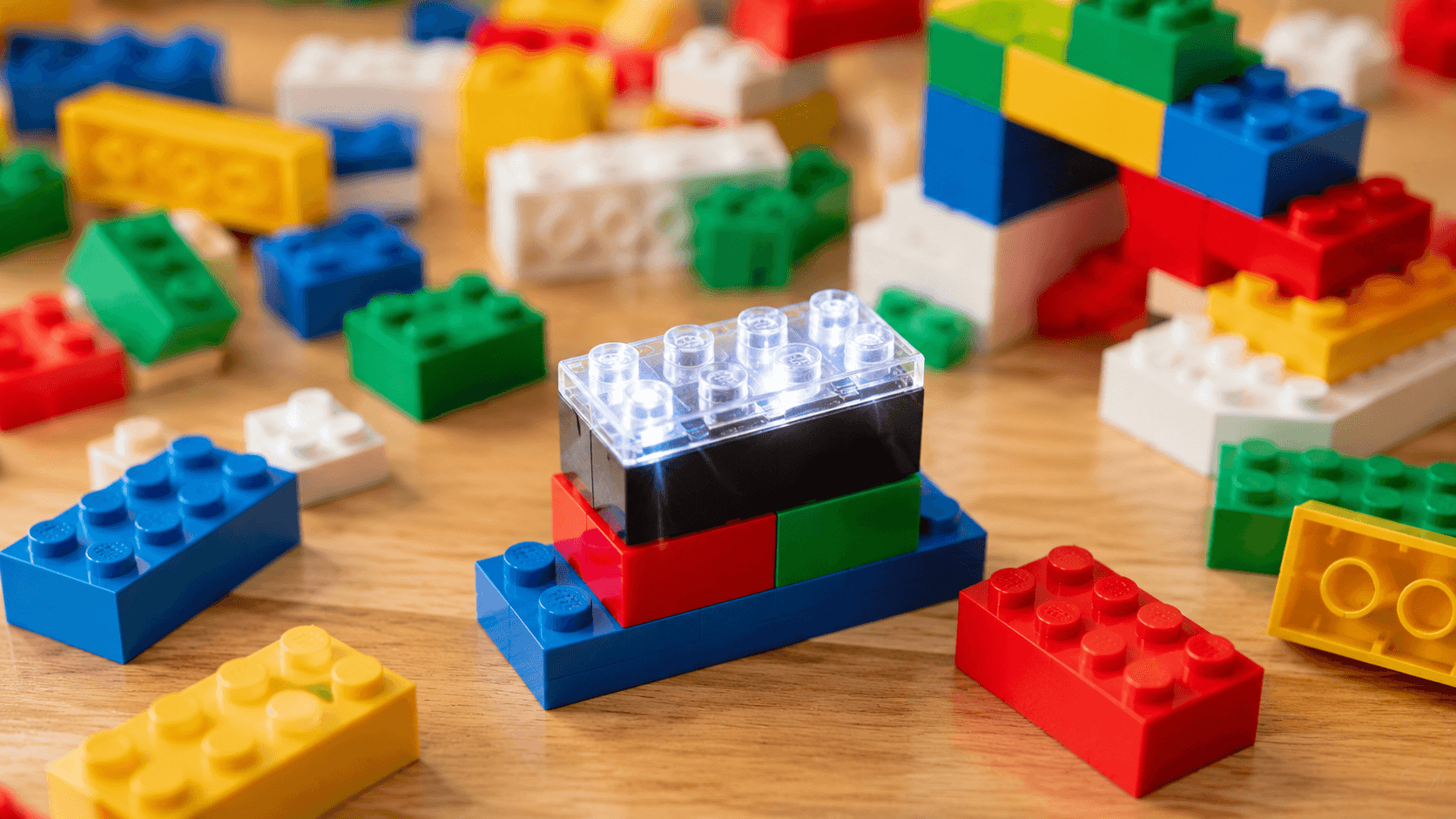
At first glance, the LEGO SMART Brick looks like a traditional LEGO brick of 2 × 4.
It can be integrated into a building like any other room. Yet under its plastic surface is a real small computer specially designed by LEGO.
Smart brick includes:
- a customized electronic chip;
- an accelerometer to detect movements;
- different sensors;
- LED lights;
- a miniature speaker;
- an integrated sound synthesizer;
- a wireless communication system;
- a small rechargeable battery;
- a wireless charging mechanism.
LEGO asserts that the chip developed for its system is smaller than one of the circular heads visible on the top of a brick.
The set represents an impressive miniaturization feat, especially when it is considered that the piece must remain strong enough to be handled as a real toy.
Three elements for building life
LEGO SMART Play is not just based on smart brick.
The system combines three categories of components.
The SMART Brick
It is the technological core of the system.
It analyses movements, recognizes certain elements placed in the vicinity and produces the appropriate light or sound effects.
When installed in a vehicle, for example, it can adjust the sounds according to how it is moved.
SMART Tags
SMART Tags are small parts that can be integrated into constructions.
They contain information enabling SMART Brick to recognize a particular object, situation or action.
A building can therefore react differently depending on the beacon detected.
SMART Minifigures
Some figurines also have a particular identification.
When the smart brick recognizes a compatible figurine, it can produce sounds or behaviours corresponding to the character.
The technology thus gives the impression that bricks understand the scene created by the user.
The toy now reacts to how it is handled
The real novelty of SMART Play is not only the presence of electronic components.
It is in the capacity of construction to react to physical play.
A ship moved in the air can produce an engine sound whose intensity varies according to its movements. A building can recognize an attack, a collision or the arrival of a character. Lights and sound effects may change depending on the orientation or action performed.
The result gives the impression that the model partially understands what the user is imagining.
This approach is very different from traditional interactive toys, which often simply produce the same sound when pressing a button.
Instead, SMART Play seeks to interpret movement and context.
Construction is no longer content to wait for an order: it reacts to the way it is used.
An advanced technology that does not rely on artificial intelligence
At a time when manufacturers add the "IA" label on almost all their products, it is interesting to note that LEGO SMART Play does not rely primarily on artificial intelligence.
Instead, the system uses sensors, proximity communications and contextual programming.
He does not attempt to generate stories automatically, film the user or analyze his face.
It doesn't include a camera either.
The brick does have a microphone, but LEGO explains that it works as a sound sensor rather than as a device for recording conversations.
This distinction is important for a product intended primarily for children and families.
Technology remains sophisticated, but its operation is deliberately limited and relatively predictable.
The bold bet of the game without screen
The most interesting feature of LEGO SMART Play is probably the absence of a screen during the game.
LEGO could easily have designed a mobile application that was central to the experiment. Several toy manufacturers have already adopted this formula.
Instead, the Danish company chose to integrate technology directly into the parts.
The user therefore continues to build, move objects, invent scenarios and manipulate characters with his hands.
Electronics accompanies imagination without necessarily replacing it.
This is a particularly relevant choice at a time when children and adults are already spending a significant part of their day in front of a phone, tablet, computer or television.
SMART Play does not try to install LEGO in a screen. It seeks to bring certain possibilities of the digital world into physical bricks.
An application may still be necessary for some technical updates, but it is not intended to become the center of the gaming experience.
Star Wars opens the way
The first SMART Play sets were marketed on March 1, 2026 in the world of LEGO Star Wars.
This choice was almost inevitable.
The ships, laser swords, fighting and characters of Star Wars lend themselves particularly well to sound and light effects.
The SMART Brick can reproduce engine noises when the user moves a ship, recognize certain characters and accompany movements with different effects.
For LEGO, this first collection was a logical way to demonstrate the capabilities of the system.
But the real expansion of SMART Play came a few months later.
LEGO and Pokémon gather two generations of memories
On June 2, 2026, LEGO and The Pokémon Company announced a new collection including 12 LEGO Pokémon SMART Play sets.
These packages were marketed on August 1, 2026.
The collection includes several well-known characters, including:
- Pikachu;
- Charizard;
- Squirt; Bulbasaur;
- Eevee;
- Mewtwo;
- Gengar;
- Jigglypuff;
- Lapras;
- Umbreon;
- Garchomp.
The technology allows constructions to react to different actions. Users can in particular train their Pokémon, interact with them or simulate clashes using SMART Bricks and SMART Tags.
This collaboration is particularly clever.
LEGO and Pokémon both have an audience composed of children, but also adults who grew up with these universes.
Nostalgia therefore becomes an important engine as technology.
Some will buy these sets to play. Others will want to collect them. Many will simply be curious to see how two elements of their childhood have been transformed by modern electronics.
Not all sets include smart brick
However, attention needs to be paid to how LEGO markets its new ecosystem.
SMART Play products are divided into two categories.
All-in-One sets
These sets contain everything necessary to enjoy interactive functions:
- one or more SMART Bricks;
- a charger;
- SMART Tags;
- compatible characters.
In the Pokémon range, the Pikachu Training House includes a SMART Brick, while the Charizard set against Jolteon contains two.
The US launch prices were US$69.99 and US$119.99 respectively.
Compatible sets
The other sets usually contain SMART Tags and characters, but not necessarily the SMART Brick or its charger.
They can be assembled and used as traditional LEGOs, but you need to transfer a SMART Brick from an All-in-One set to enable their interactive functions.
This difference can easily lead to confusion.
A set presented as SMART Play compatible does not automatically contain all the necessary technology.
A platform designed to evolve
LEGO does not present SMART Play as a simple temporary collection.
Instead, the company talks about a platform that will continue to evolve with new characters, new tags and new functions.
The LEGO SMART Brick also contains some sensors that were not yet fully exploited at the time of launch.
According to an analysis published by The Verge, certain capabilities related to ambient light, position or orientation were not yet activated in the first sets.
LEGO confirmed that the technology was present in the brick, but that certain functions could be used in future products or gradually activated.
This means that the first SMART Bricks could acquire new capabilities as the platform evolves.
This is promising, but it also shows that SMART Play remains a first-generation product.
# Still limited autonomy
The miniaturization of SMART Brick leads to some compromises.
The integrated battery is tiny and the active range of the first models was estimated at about 45 minutes. Fortunately, brick uses different watch modes to avoid unnecessary energy consumption when it is not handled.
It must then be placed on its wireless charger.
Even more worrying, the battery does not seem to be easily replaced by the consumer.
This choice raises an important issue regarding long-term sustainability.
A traditional LEGO brick can be preserved for decades. It can move from one generation to another without really becoming obsolete.
An electronic brick containing an integrated battery does not necessarily have the same life expectancy.
For a company whose products are known for their exceptional longevity, this point deserves to be monitored.
The risk of transforming simplicity into a closed ecosystem
SMART Play also raises another issue.
Traditional LEGO bricks are universal. A piece made today remains compatible with a construction that has lasted several decades.
The electronic part of SMART Play, however, operates in an ecosystem controlled by LEGO.
The reactions depend on SMART Tags, recognized characters and the behaviour programmed by the manufacturer.
The user can always build what he wants, but smart functions remain linked to the possibilities provided by the platform.
There is therefore a delicate balance to be maintained.
If the technology remains discreet and flexible, it can enrich the imagination.
If it becomes too directive, too specialized or too dependent on specific collections, it could, on the contrary, limit some of the freedom that has been LEGO's success for generations.
A bigger innovation than it looks
A brick that produces sounds may seem less impressive than an augmented reality helmet or a robot powered by artificial intelligence.
Yet LEGO SMART Play is a fascinating technological innovation.
The challenge was not simply to add electronic components to a toy.
A system had to be created:
- small enough to enter a brick;
- resistant enough to be handled regularly;
- simple enough to be used by a child;
- discreet enough not to replace physical play;
- scalable enough to feed future collections;
- compatible with the traditional LEGO system.
According to LEGO, SMART Play brings together over twenty patented innovations. Its development would have required several years of research.
The company describes this platform as one of its most important developments since the appearance of the modern LEGO figurine in 1978.
Who is LEGO SMART Play for?
The product obviously targets children, but its potential audience is much larger.
It should attract:
- families wishing to offer interactive activities without screens;
- LEGO enthusiasts;
- collectors;
- Star Wars enthusiasts;
- Pokémon admirers;
- nostalgic adults who grew up with these universes;
- curious people interested in electronic miniaturization.
The first Pokémon sets are recommended from six, seven, eight or ten years depending on their complexity.
But it would be surprising that adults do not represent a significant portion of the market.
Our verdict on the gadget of the week
LEGO SMART Play is not perfect.
The range remains limited, the non-replaceable battery raises concerns and certain functions in the equipment are still waiting to be operated.
It should also be carefully checked whether a set actually contains a SMART Brick or whether it is only compatible with it.
Despite these reservations, the concept is remarkably well thought out.
LEGO could have simply connected its toys to a mobile app. The company has chosen a much more difficult path: miniaturizing the technology so that it disappears behind the physical experience.
So the real success of SMART Play will not depend on the amount of electronics contained in the brick.
It will depend on LEGO's ability to preserve what has always made its toys special: the freedom to build, dismantle and imagine something else.
The brick of the future always resembles that of the past
For a long time, giving life to a LEGO building simply required a little imagination.
The engine sound came from our mouth. The characters spoke with our voice. The ships were flying because we held them above our head.
With SMART Play, the brick can now add its own sounds, recognize certain characters and react to our movements.
But she still doesn't build anything for us.
She doesn't decide history.
It does not replace the hands that assemble the pieces.
Perhaps this is where LEGO SMART Play's greatest success lies: to introduce IT into one of the world's most famous toys without completely removing its soul.
For children today, it is a new way of playing.
For those who have grown up with a huge bowl full of mixed bricks, this is especially proof that their childhood memories can still evolve with technology.