Three days away from a catch: the POCO M8 Power is our gadget of the week
Discover the POCO M8 Power 5G, our gadget of the week, with its 8,000 mAh battery, AMOLED 120 Hz display and inverted charging.
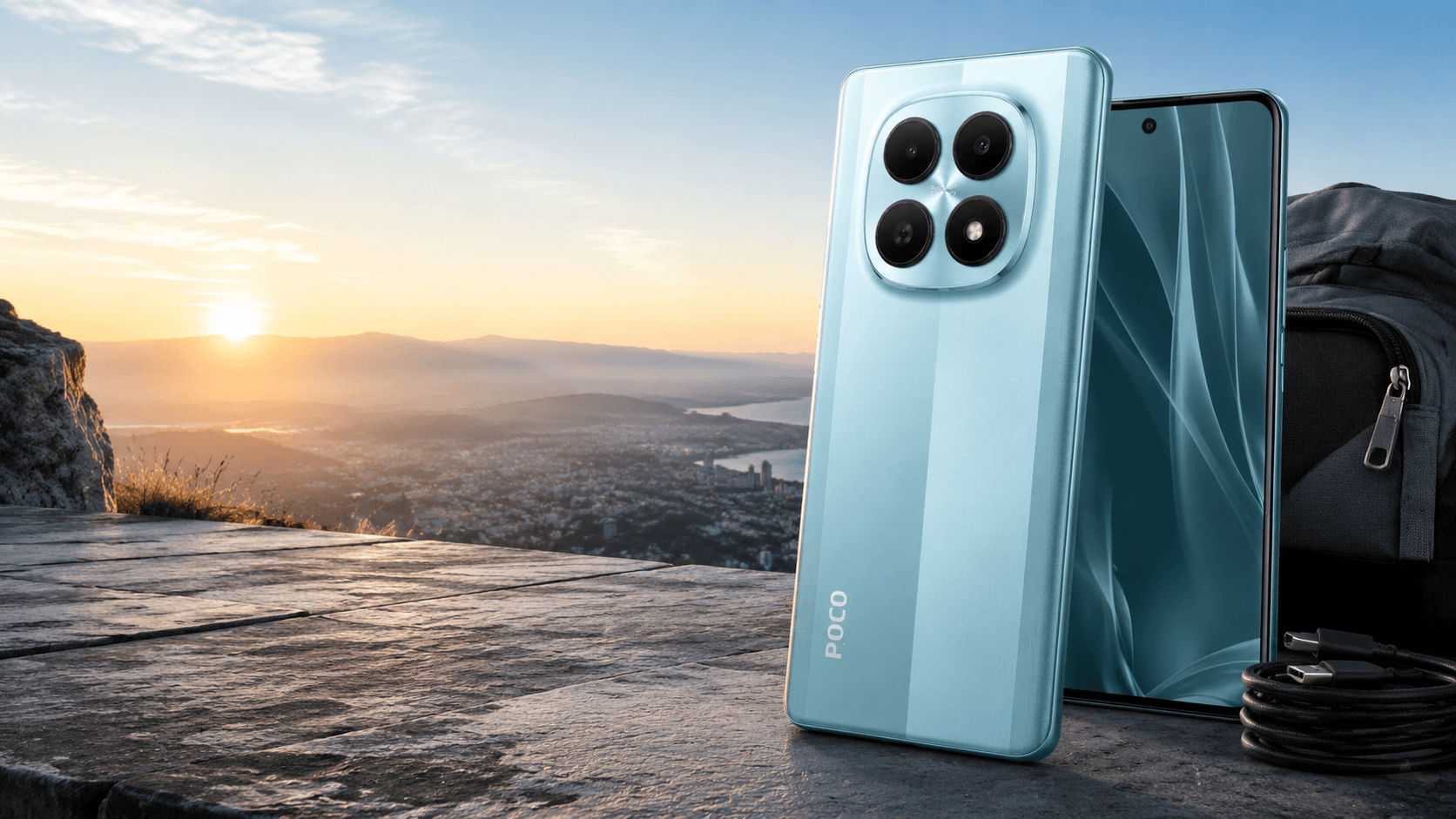
- With its huge 8 000 mAh battery, the new POCO phone does not seek to become the thinnest or the most luxurious. Rather, it tries to solve a concrete problem: autonomy. *
The smartphone market is filled with similar devices. Each new model promises a slightly faster processor, a camera with a few extra megapixels or an artificial intelligence function whose utility is sometimes uncertain.
POCO M8 Power 5G, officially presented this week in India, takes a different approach. Its main argument is not a spectacular function, but a feature that all users can understand: a battery of 8,000 mAh.
This represents a considerably greater capacity than the batteries of about 4,500 to 5,500 mAh that are usually found in modern phones.
For this reason, the POCO M8 Power deserves the title gadget of the week.
A battery almost unreasonable
POCO announces a range of up to three days depending on the use. As always, this statement will have to be verified by independent tests carried out under real conditions.
Even if the telephone does not systematically reach this time, a battery of 8,000 mAh should provide a significant margin of safety for intensive users.
This autonomy could be particularly useful for:
- Mobile workers;
- Passengers;
- Field technicians;
- People frequently using GPS navigation;
- fans of mobile games;
- Content creators;
- Users living in areas where power supply is less stable;
- People who just forget to charge their phones.
The choice of a large battery seems almost obvious. However, the majority of manufacturers still prefer to design ever thinner devices, even if this forces their owners to look for an electrical outlet before the end of the day.
POCO makes the opposite bet here: accept a potentially thicker and heavier device to offer a truly higher autonomy.
A silicon-carbon battery
The capacity of 8,000 mAh is made possible by the use of a battery with silicon-carbon.
In a traditional lithium-ion battery, the anode is generally based on graphite. The addition of silicon theoretically allows to store more energy in a comparable volume.
This technology represents an important development for mobile devices. It could allow manufacturers to increase autonomy without turning their phones into huge bricks.
However, silicon presents several technical challenges. In particular, it can change volume during charging cycles, which can affect battery durability if its design and thermal management are inadequate.
The real test of the POCO M8 Power will therefore not only be its autonomy during the first weeks. It will also be necessary to check how its battery behaves after several hundred recharge cycles.
#A quick but reasonable charging
The phone supports a wired charging of 45 watts.
Some competitors offer much higher powers, sometimes more than 100 watts. However, increasing the charging speed can produce more heat and accelerate battery aging if the system is poorly controlled.
A 45-watt recharge is therefore a reasonable compromise between speed, temperature and battery preservation.
The telephone would also offer an inverted charge of up to 22.5 watts. It could be used as an external battery to power headphones, a watch, another phone or a small compatible device.
This function gives real meaning to the word "Power" in its name. The POCO M8 Power is no longer just a phone with a large battery: it becomes a transportable energy source.
A large AMOLED screen at 120 Hz
The POCO M8 Power has an AMOLED display of approximately 6.83 inches, with a Full HD+ resolution and a refresh rate of 120 Hz.
AMOLED technology allows deep blacks and a high contrast, since each pixel produces its own light. The 120 Hz refresh rate makes animations and scrolling more fluid.
However, a large 120 Hz screen can consume a lot of energy. The 8,000 mAh battery becomes particularly relevant: it allows you to enjoy the display without having to constantly reduce its brightness or disable the most energetic functions.
The screen would also be protected by Gorilla Glass 7i and would benefit from technology to maintain good tactile precision when it is slightly wet.
Performance adapted to the mid-range
The phone is equipped with the Snapdragon 4 Gen 4 processor from Qualcomm.
It is not a processor designed to compete with the most expensive devices. However, it should provide sufficient performance for day-to-day activities:
- Web browsing;
- Social networks;
- Video playback;
- Courier;
- GPS navigation;
- Professional applications;
- Some mobile games.
Depending on the proposed configurations, the phone can also offer up to 8 GB of RAM and different storage capabilities.
The main camera of 50 megapixels should be suitable for everyday photos, but it would be prudent not to confuse sensor resolution with the actual image quality. Software processing, sensor size, lens and brightness conditions often influence the result more than just the number of megapixels.
A surprisingly serious software commitment
Another interesting aspect is the announced software support.
The POCO M8 Power would work with HyperOS 3, based on Android 16, and would benefit from four years of system updates as well as six years of security fixes.
For a mid-range device, this commitment is particularly important. A phone with a huge battery would lose much of its interest if it became obsolete or vulnerable after only two years.
The promise of extended updates could therefore become as important as autonomy itself. However, it will be necessary to check how quickly POCO will distribute these updates and whether all regional versions will benefit from the same schedule.
The compromises to be anticipated
A battery of 8,000 mAh does not come without compromise.
The telephone may include:
- Heavier than a traditional apparatus;
- thicker;
- Less comfortable for single hand use;
- Longer to fully recharge;
- Less efficient than some competitors sold at the same price.
Its large size may also not suit people looking for a compact phone.
The POCO M8 Power is not necessarily the best device for everyone. Its interest depends on a very specific priority: to achieve excellent autonomy without paying the price of a high-end phone.
Still limited availability
The POCO M8 Power was first presented for the Indian market. The information currently available indicates that its price varies according to the configuration and the launch promotions.
Its availability in Canada and other international markets is not yet clearly established. The compatibility of imported versions with the frequency bands used by Canadian cellular suppliers will also need to be verified.
It is therefore preferable to wait for an official regional announcement before considering an import.
See the presentation of POCO M8 Power published by Cinco Días
Why is he our gadget of the week?
The POCO M8 Power does not reinvent the smartphone. It does not offer a spectacular folding screen, an integrated projector or a strange function designed to impress during a demonstration.
He does something more relevant: he tries to solve one of the main irritants of mobile devices.
Its huge battery, inverted charging, AMOLED display and extended software support form a coherent set. Each feature helps make the phone a device designed for long and intensive use.
This logic deserves to be emphasized in an industry that sometimes seeks innovation in complicated functions while users simply want a reliable device.
The POCO M8 Power may not be the most elegant phone of the year. However, it could become the one that its owners least often forget to recharge — because they will not need to do it every day.
Verdict: ingenious and really useful. A battery of 8 000 mAh is not a technological revolution alone, but it turns a technical improvement into a concrete and immediately understandable advantage.